Showing posts with label food. Show all posts

Monday, December 28

day of reckoning

Two weeks left to go in Belgrade, and it was time for the much-anticipated pig slaughter. Milutin had been feeding the pigs a diet of acorns, barley, and rye, for the two months leading up to the fateful Sunday, and I had hatched out a plan to turn all of the meat into various cured meats, sausages, and the like. I have slaughtered my share of chickens (maybe I should write about that sometime), and killed a few fish in my life, but I have had no experience participating in or watching the slaughter of a large mammal. I sketched out a rough map, we toasted with some herb-infused rakija, and we lit cigars; the next few hours would be in the trained hands of the butcher and his assistants.

surreal lighting at milutin's houseThe lighting for the morning event was surreal and perhaps prescient: fog-thickened still air, rays of sun bursting through silhouetted oaks. The trees were long since stripped of their seeds-come-forage, but this morning was unseasonably warm, despite my numb fingertips. The nearby geese heard Milutin’s offer of one of their carcasses; they seemingly wanted nothing of it.

the plan While I saw the butcher’s work on all three pigs, I witnessed the actual slaughter of only one. I will not make it out to be a beautiful thing to see. Put bluntly, it was rather difficult to watch. Instead of a relatively peaceful shot to the head in the pen, the butcher and his men wrestled with the pig to bring it out into the open for the kill. Stress, even just these few minutes, affects the flavor and texture of the meat and is to be avoided to the point of delaying a slaughter if a pig gets too spooked. It was all the sadder since this pig had heretofore lived a wonderful life on pasture and acorns.

When finally out in the yard, the pig was positioned, and a bullet fired into its skull. The death was instantaneous, though the convulsions lasted several minutes. As the heart continues to beat for several seconds, the carotid artery is quickly severed to drain the blood into a bowl. Next the carcass is scalded and rolled in hot water to facilitate removal of the outer layer of skin and hair. The men scrub until most of the hair is removed and then finish by burning off remaining hair and skin with a large propane torch. The pig is hoisted up from the branch of a tree, eviscerated, beheaded, and hacked in half lengthwise. Shoulders for coppa and sausage, loins for lonzino, jowls for guanciale, legs for prosciutto, belly for bacon, and remaining fatback for lardo. Hearts, lungs, and blood would make a blood sausage recipe I learned in France. Liver would combine with some extra belly to make a rich pâté.

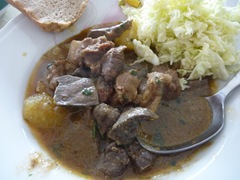
mmm: lungs and liver and sleen, oh my! As the last of the parts were carried into the outhouse to continue to cool (this would be difficult today, as the sun had broken through the fog and it was 8C and rising), we headed up the hill to the home of Milutin’s parents-in-law for some offal goulash. The variety meats for this stew came from the first pig slaughtered earlier that morning. It quickly became clear why this stew is a slaughter day tradition: we were chilled from the cool air and famished from a lack of breakfast since we had awoken six hours earlier. It was hearty, well-spiced, fatty, and even for me some of the textures were somewhat difficult to handle. Still, I scarfed down several helpings. The ubiquitous cabbage salad, tangy with apple cider vinegar and seasoned only with salt and sunflower oil, was a great counterpoint to the rich goulash. We loaded up over 150kg of pig parts into the car, the bulk of work still ahead of me.

Saturday, December 12

grilled tubes

“Tubes” are the best commonly understood translation of intestines between me and the cooks. When I need to stuff sausages, I must remember to ask for tubes, not casings or intestines. I have eaten my fair share of such things. Sausages: no problem. “Pig a**hole” in Chinatown: sure. Funky rolled-up lamb intestine stew at a nearby kafana: actually liked it. Tonight, though, I was stumped. Mirko and I, given that we will soon be parting ways, went out for dinner at the oldest restaurant in this part of the world. Named simply with a question mark “?,” it is known for its age and its traditional Serbian cuisine.

I pride myself for eating, or at least trying, anything and everything. So I was actually looking forward to the grilled “tubes” tonight (further down the digestive tract, these were not the thin things one stuffs with fresh sausage: these are thick-skinned, funky-smelling parts of the pig’s digestive tract. Upon first sniff, I knew it would be difficult. The first bite was even more succinct in its message: no way. I tried a second and a third time, with raw onion, with mustard, but to no avail: this was one dish I could not handle. The rest of the food was good: nice sauerkraut and piktija (pig head cheese, Serbian style), and decent “veal cooked under brick.” At the end of it all, while I dug through my pockets for cash, Mirko disappeared and settled the tab: it’s impossible to pay for anything in this country. Next time, perhaps (eating and paying, I suppose), for if at first you don’t succeed, try, try, try again…

Tuesday, November 24

lightning round, nagar style (1/2)

I have had no time for writing of any kind this past week. Work gave way to my family’s arrival ten days ago, and I was destined for the role of tour guide extraordinaire. They arrived without their luggage, a frequent occurrence in these parts, it turns out. Their airline, however, was kind enough to give them some spending cash to compensate. Cash in-hand, with them I was finally able to explore some of the Serbia I have been too busy to see. Here is part I of a brief recap, to the best of my memory.

We spent the first couple of days getting acquainted with Belgrade proper: a trip to Kalamegdan fortress (a simply beautiful place to stroll around), a walk down the pedestrian-zoned downtown Knez Mihailova street (shop til you drop—literally: you’ll faint at the high prices on anything produced outside of Serbia), a visit to the Jewish History Museum (enlightening) followed by a look inside the only operating synagogue in Belgrade. The weather was highly cooperative—mostly sunny, usually warm enough to eschew heavy coats. We visited some new (to me) restaurants. For the sake of documentation, Lovac, a game restaurant, was largely a disappointment. Šaran, however, an old fish restaurant in the old neighborhood of Zemun, was great. Zaplet (where I work) was the overall favorite, my mom especially enjoying traditional food that reminded her of what she ate as a child in Israel.

Unable, at the last minute, to join us on a trip to Mokra Gora, Vladimir instead arranged for us be driven in a friend’s car. An amazingly generous and ridiculous gesture, an extremely polite man by the name of Ivan drove. Since Shiri, Viktor, and I had gone out late the night before, I was in and out of consciousness for the spectacular drive. The landscape was stunningly beautiful and we drove by numerous small towns and through thousands of acres of farmland. The trip was largely an excuse to relax and be away from the bustling city. We arrived and started a fire in our cozy wood cabin. We napped, ate, and talked about various business and investment ideas (typical Nagar conversation). It was nice to sleep a bit and we all enjoyed exploring the surroundings, hiking down the hill to a nearby village in search of a fabled farmers’ market we had been told to visit, but could not find. So we began the lazy return to Belgrade.

We stopped in Užice to visit its farmers’ market. There, we found some great kajmak and fresh goat cheese from a man selling a variety of dairy and smoked meats. We also stocked up on apples and pears, buying some homemade wine from the same woman. Yes, homemade wine, at an open-air market. Homemade wine sold in a variety of old soft drink bottles. Did I mention I love this country and its lack of regulations? Where else can you buy this kind of stuff? Onward, we stopped at a floating restaurant on the bank of a river. Old men fished from the restaurant’s patio and from nearby boats. Sadly, though the fish was ostensibly fresh, grilled really meant deep-fried to an overcooked dark brown. Indicative of the relaxed Serbian mentality, the wine I had ordered upon first sitting arrived toward the end of our hands-on fish eating contest. Since we were going to have the main course on down the road, we sent it back and got the check instead. The next place was a nondescript house marked with nothing but its address. Ivan heard about it from a friend who lived nearby, and it served only traditional Serbian style veal breast, slowly roasted. An excellent main course, though quite too much food, as usual. Judging by the shape of the car when we returned, Ivan managed to remain awake for the rest of the drive back; none of us were so successful.

Stay tuned for the second part of this exciting tale!

Tuesday, November 10

butchering buša

Though I have experience butchering small livestock, before last week I had never really done any in-depth butchery with beef or veal. Last month, knowing that we would have the opportunity to work with less common animals such as Mangalitsa pigs and Buša cows, I sought out advice on the best uses for their various parts. Mangalitsa pigs turned out to be well-documented thanks in large part to Heath’s efforts at Wooly Pigs’ in Washington state. Buša cows are another story entirely—searching several permutations of the name turned up next to nothing, besides some very basic technical information about the breed. At one point, though, I found an email address for a man named Zoran, listed as the Buša breeding contact in Serbia. I wasted no time getting in touch with him, and he was quick to respond to my inquiries. Not only did he give me further information about the Buša cows, but it turns out he raises Mangalitsa pigs as well.

It seems that Buša were traditionally raised by subsistence farmers in the mountains where the milk, rather than the meat, was the primary product. As such, the cows would typically be slaughtered at an age approaching 15 years—resulting in meat more suitable to braises and stews than anything else. In any case, Zoran promised to be in touch when the time approached to slaughter one of his animals.

Last week, as promised, he wrote me of a Friday slaughter of his Buša bull, 1.5 years old. I quickly replied, and we agreed that Vlad and I would drive out to their town of Vršac to see whatever we could. As the slaughter was early in the morning, we skipped it and instead drove straight to his house, where we were invited in to meet his beautiful family as well as his butcher of 50 years’ experience. This was indeed a family affair, attended by his wife and two engaging children, as well as his mother and father. The butcher, in a fashion I’ve never before experienced, had meat spread out across the wooden dining table, using a small cutting board to do the work.

I cannot say enough good things about the experience. It just struck me as the right way to approach the meat we eat. Here were two young kids, playing with the bones, watching the butcher at work, and helping to take the meat upstairs (where it would be laid out on the floor to rest overnight before being frozen or further processed/cooked the next day). Zoran gave us tastes of his friend’s acacia honey, his father’s two year old bacon, the last of the season local grapes, some grassy fresh goat cheese, and his own unfiltered apple cider. Zoran’s wife, a physician, told us of the healthy nature of the Buša’s omega-rich fats, pointing out bone marrow (love it) and fatty cuts, mentioning the liver as especially beneficial to the kids, with its concentration of iron and vitamins. The event seemed straight out of Barbara Kingsolver’s Animal, Vegetable, Miracle (I recently finished reading it).

While we came for ideas in using the veal we had at Zaplet, we left instead with a warm fuzzy optimistic feeling about family and life. And death: the butcher went on to show us how he kills the animals, with a purposefully-designed gun made by none other than F. Dick, better known for their utilitarian knives. We had to run back to Belgrade before the family had a chance to put me to use in the kitchen, but they have an open invitation at Zaplet. I look forward to our next encounter, and hope that I can provide as well for my future kids.

Monday, November 9

nice hams

Sunday night I went for a ‘quick drink’ with Viktor, and almost made it out of Scandal by 1:30. Viktor said ‘one more,’ and I took the bait. Having finished, the server delivered another round, this time on the house. Again, we drank and almost exited, but the Karaoke band said they’d sing another song before calling it quits for the night, and so we of course stayed. Once again, I found myself falling asleep at 4:00, usually not a problem on a Sunday night. I had to meet Vlad at nine, though—we had an excursion planned to visit one of Serbia’s best Prosciutto makers.

Zombie-like, I trudged up the street to our rendezvous point. I, the dwarf American, moved quickly to the back seat when we picked up Vlad’s friend Dragan, a former basketball star—even in the front seat, his knees were up against the dashboard. We chatted and talked about the sights on the way. About halfway through our drive we stopped at a café on the road. Inside was a scene out of an old detective movie, sunlight pouring through thick, smoky air atop red-checkered tablecloths. The large space was occupied by but three old men passing the time. One of them got up and took our order, hot tea for me. Our drinks arrived, and I sipped my Serbian tea—Vladimir had modified my order. No, the Serbs don’t grow tea high up in their mountains; Serbian tea is hot sweetened Šlivovic (plum brandy). Still before noon and slightly buzzed, I picked up a few fallen pears by a well-endowed tree—they’d make good post pork snacks.

We were met by a lead car for the last confusing yet beautiful countryside stretch of road to Mirko’s pršut (prosciutto) plant. The building that houses the prosciutto works is quaint and sparse. We were led on a tour through the wing where the magic happens, up on rafters above the ground floor where a fire pit is used for some gentle smoking a few days each year. Mirko hails from the Dalmatian coast of Croatia, where he first learned his craft in a much more Italian tradition. He searched long and hard for land with just the right year-round breeze and climate, settling finally in the hills of Cajetina. The clean country air rarely climbs above 20°C, making it an ideal spot for this venture.

The extent of our hours-long stay at the house that was translated to English can be summed up in this one paragraph; I did ask lots of questions, but Serbs love to talk, so by the time my question received a long-winded answer, it was either forgotten or just lost in the transition to a tangent. The hams are first salted for several days before being rinsed and again salted, this time pressed between layers of wooden planks for several weeks. They are then finally hung up to begin the two-year drying process, with the occasional waft of smoke (most Serbian pršut is very heavily smoked) and a constant breeze through the windows. They get coated with chalk dust in three monthly stages beginning in April of their first year, first the area where exposed bone meets meat, followed by where skin meets meat, and then finally coating the entirety of the ham. When ready for consumption they are rinsed of the protective coating and packaged as required.

Mirko, at the behest of the German laboratory who tested his products, has begun to experiment with hams that are not smoked at all, and is slowly phasing out smoked products altogether. Still, even his smoked pršut is hardly so. We were invited to sit down to a tasting of all his products, beginning with the obligatory brandy before moving on to a homemade entirely refreshing white wine. Ravenous, we travelers dined with vigor hardly surpassed even by the fabled Oliver Twist. The prosciutto was well-made, but salty to a fault. The pancetta (cured bacon, really), however, was on point and worth every calorie. The culin (a regional smoked sausage spiced with paprika and rather similar to Spain’s chorizo) was very good, though might have actually benefited from some of the ham’s extra salt.

We nearly ate the platter bare before Mirko quietly snuck out to slice another entirely unnecessary round. We broke out more wine to accompany the excess meat, and satiated quickly went the way of bursting. I, frustrated by my lack of ability to understand more than the occasional word, took to the wine with gusto to be sure to completely dehydrate my over- yet still malnourished body. The wine coupled with my lack of rest culminated in my neck going floppy for the three hour ride to Belgrade. Though I slept the whole way, my neck was sore from all the turns. The illness I felt was reminiscent of my binge on wild plums at Crozefond years ago, though this one was decidedly less healthy-feeling. Killer pigs reigned in my dreams that night.

Wednesday, October 28

lazy day ends with fish?

My day off yesterday was lazy and relaxed. After another late night out with my Kazakhstani friend Viktor (yes, I was originally wrong about him being Russian, though it’s his mother tongue, and he has family from both countries), I again felt a cold coming on, though I set my alarm clock for only six hours of sleep—too many things to try and catch up on. I woke up at 10:30, hit snooze, and brought my phone back into bed with me. My flat gets little natural light, so what felt like a plausible 10:40 turned out to be 2:00pm. Argh!: I had made a mess of my plans.

I spent most of the afternoon with Miloš, lazily making our way around town. I had my brunch finally at 4:30, the Serbian staple of pasulj sa mesom (beans with meat—I’m still gassy J). We visited one of Belgrade’s newest shopping malls. We toyed with the idea of an evening movie, but the choices were sparse and, frankly, awful. I finally got to walk through a Serbian supermarket, and stocked up on muesli for breakfast. The fresh produce section was unsurprisingly thin given the surplus of meat products that are so popular with the locals. The dairy section was surprisingly focused on processed and ultra-pasteurized given the country’s agrarian pride. I couldn’t stomach looking too closely at the meat section: there is sadly not yet any demand for the kinds of meats Milu is traditionally raising, and I honestly eat way too much meat here.

After some downtime at home I finally met with Vlad for dinner. We went to a Montenegrin family-owned restaurant at a weird out-of-the-way intersection. Inside was decorated like something from centuries past, and the servers wore weird sailor outfits. Their claim to fame is the quality of their seafood, brought in daily and undeclared (apparently the tax collectors enjoy eating here too) from the docks of a small bay in Montenegro. We started with beautiful local (to the Montenegrin coast) clams simply grilled and doused in olive oil. Simple. Wonderful. Alongside was a scallop, gratineed with Parmigiano. A sad thing, and a wasted life, given the dominance of the cheese. Our main course were a couple of small fish, roasted whole in olive oil among fall vegetables. One was a rare Mediterranean fish called Cavala, the other a similar but more common Dorado. It was so simple and so delicious. The vegetables were permeated with the wonderful sweetness of the fish and the olive oil. Everything was perfectly seasoned. The fish was impeccably fresh. The wine was local and perfectly-suited to the food. This was old-school fish cookery, and is what this restaurant excels at. The manager (Vlad’s friend) joined us for a sip of very old Guatemalan rum (Zacapa 23 year old, for those who care) after dinner, and we left feeling wonderfully buzzed with the high of a great meal. Sometimes it’s the simpler preparations that make a meal really work.

Monday, October 26

serbian stallion

Sure, its name doesn’t have quite the ring of its Italian cousin, but what’s in a name anyway? I had heard of it while in Morocco. Had been tempted by the prospect of trying some French cheval. True Belgian pommes frites use such fat as their key ingredient. And here I finally was, the moment of truth: my first bite of horse. Vlad took me to the aptly-named White Horse Club just around the corner from my flat. It was just for a light snack while planning the coming weeks and food ideas. So, after starting with the requisite rakja (brandy), we were delivered our plate of horse tartare. I was excited, but was underwhelmed by the momentous first bite. It was rather bland, and rather than chopped, it was finely minced and whipped into more of a paste than tartare, with no noticeable seasonings at all. Served simply with butter and sliced onion and cardboard-resembling tomato, the jar of salt I carry with me came in handy to liven it up. Like many other firsts, I hope it gets better the more times you try it. Next time I’ll make sure to try some stallion sausage—I’ve heard good things.

Tuesday, October 13

of hairy pigs and bloody butchers

On Sunday Vlad and I awoke early to drive to his friend Milu’s home in the hills near Belgrade. There was a special event: this was the morning one of his prized mangalitsa pigs would be slaughtered and we, at the restaurant, would help prepare and preserve a fair part of it. Sadly we were not early enough: by the time we arrived the blood was already spilled, the pig skinned, and mostly hacked into individual portions. We

managed to salvage a bone-in (but skin/fat-off) loin, a leg and the skinless jowls. The rest that we took with us was already cut into pieces. So, after much stress about nothing, I realized I need not have worried about it: the parts we had left would dictate their own uses. The scrap and leg, I marinated and made into rillettes and sausage (much of it destined for Milu’s freezer). I’ll use some of the jowls’ fat to enrich the sausage, as much of the fat had been trimmed. The loin, we will roast whole tomorrow for Milu and his party of fifteen. The rest of the jowl, we haven’t figured out yet; hopefully tomorrow.

Milu, an investment banker and lover of food, has taken it upon himself to save some of the Balkans’ rarer breeds. He has a herd of indigenous Buša (pronounced: boosha) cows, a breed that is full-grown at 200kg and will eat grass throughout the winter, digging up to a meter in the snow to find vegetation food. He has sheep and goats that are nearly extinct (I lack the details on their breeds).

Both sexes of the sheep grow long horns. And there are, of course, the mangalitsa pigs, one of the most primitive swine family members, with a short, stocky body, and hairy coiffeur (generally dark brown, though I took pictures of a couple he has that are blonde—a recessive gene, Milu explained). These pigs are suited for charcuterie, with 3:1 ratio of fat to meat, I’m told. I really admire what he’s done (though I did not see most of the animals, as they’re tucked away on a mountainside pasture he has purchased to raise them), and we talked for a bit about the logistics (and challenges) of harvesting and selling some of his livestock. Serbia, it turns out, might not be ready for these fancy animals, as they likely would not fetch their true value on the market, so for now, he continues to grow the herds rather than harvesting animals.

In any case, we made the best of our time up in the hills. I had a chance to meet some of Milu’s animals: long-haired mangalitsa pigs, geese, chickens, and turkeys. I ate fruit fresh off his pear and fig trees, and ate the four raspberries I spied desiccating on the vine. We sampled their tomatoes and grapes, and I marveled at their beautiful abode just up the hill from the mini farm/in-laws’ house.

Their home is beautiful: an old 18th century home transplanted from an old village in Serbia and added onto with some modern touches, yet keeping its vintage charm in the first floor sitting room (photos to come). His wife Mila taught me her ajvar recipe (more on this fantastic food to come in a separate post), as I loved her version, and we drank green tea while snacking on their fruit preserves (straight out of Christine Ferber’s great book, Mes Confitures).

Back at the farm we picked up our still-warm pork, but not before gorging ourselves on the cracklings left from the lard that had been rendering over a wood fire all morning. This country is great. We’ll be returning at the end of November to slaughter four more pigs, this time with more planning, and hopefully some prosciutto by the end of next year if all goes well… In any case, I left mesmerized (and on my way to a full blown cold, which I love complaining about; no shock to those of you who know me), with a new slow food hero to add to my list of people I admire.

Coming soon: I’m officially a tv star and the truth behind wonderful, mystical ajvar!

Saturday, October 10

chickens and veal and pigs, oh my!

Contrary to what I (and probably many of my friends and family) would like to believe, I am actually working out here. No need to report me to the authorities for violating my work visa, please, it’s just that even I forget sometimes. Still, somehow I’ve managed to have a few stressful days, even with my often short shifts. Yes, somehow 10-12 hours has become, in my mind, a short shift. I digress. In a really cool, flattering way, I have complete freedom to create what I want with whole lambs and pigs. Some of my favorite preparations are old-school methods involving slow-roasting and braising. In fact, I’m often more interested in eating a melting braise than the more toothsome roast.

Four veal heads arrive today. I’ve cooked a veal head before and it came out quite nice, thank you, but have never had the opportunity/challenge of actually peeling the face from the bone. The one time I’ve encountered a veal head was in France, on my previous real out-of-country adventure, and the butcher magically took care of it within mere minutes. Today I get to learn on the fly. Best part about it: five hours into my day, Vlad and I leave for a football match; the lines of work and play ever blurred…

On Sunday I am told we’re driving out to the countryside early to witness the slaughtering of a banker/farmer’s pig (look for pictures next week!). Not any ordinary pig, this is a fatty indigenous black-haired, red-meat animal known as Mangalitsa. I’m to come up with how to use most all of the carcass. In many ways an awesome opportunity, I have my apprehensions. I also find it saddening that I will not be here to sample some of the products that will take months to mature: bacon, cured leg (jamon or prosciutto), cured lard. Another reason for a return vacation, I suppose.

So what’s stressful about this situation? Why am I whining (well, actually, I didn’t think I was whining!), you might be asking? I lack the team and support structure I had back in the US (thank you all). I have learned a lot from my experiences, and have great ideas, but it’s difficult to execute them when the restaurant’s butcher himself uses dull knives and does not speak a lick of English. There’s something I have yet to put my finger on, some sort of hands-off approach to teamwork, where I can be in the weeds, but the guys beside me banter and pour themselves tall glasses of Coca Cola. All day long I hear Serbian, with only the occasional translation. I’d love to learn some, and plan to, but am having trouble with the software I’ve downloaded. Still, I love this sort of challenge. I thrive under this sort of stress and pressure. And, frankly, I love that when I finish my list, or at least my task at hand, that I can go sit on one of the sidewalk chairs by our back door, and take a breather. I suppose that in itself is what makes this all seem like vacation. What an awesome gig: I get to play with my food and eat it too.

Wednesday, October 7

cook=hit man?

We bring an inordinate amount of food to our catered affairs. This is a departure from the large-scale catering I came to know in New York, as well as from my own small-scale side business. A couple of extra portions, perhaps. And reasonable portions, at that.

Back in the day, Vlad explains, when the mafia ran rampant and killed people, they had a particular style about them. Not that mafia killings will ever really end, they’re just more underground (underwater?) now. After the victims were gunned down, he continued, cocking his finger as if pulling the trigger of a gun, they would get one final shot in the head—just to make sure they were dead—bang!

It turns out cooking in this country has some mafia ties, as Vladimir elaborated on the origin of his approach on cooking for clients. After the kebab and the beautifully-roasted lamb, we gave each in this particular group one pork rib. Who knew you could find such symbolism in catering? If the pork rib is the proverbial last bullet to the head, though, then what of the molten chocolate dessert complete with huge ball of ice cream?

silver

We recently catered a party for the national basketball team’s coach. Serbia recently won silver in the European championships, and for this young team that was a big deal. By American standards, the family lives really well: indoor pool, basketball court in the back yard, a full-on homing pigeon setup. Yes, pigeons! Not only did he take his team to second place, but he’s apparently known as quite the pigeon trainer.

The party was quite the spectacle: a famous Serbian band playing the music, all manner of middle-aged well to do folks dancing and singing and living it up. I was put to use as the raw fish guy. I prepared ceviche and sashimi of a large Mediterranean grouper (Emperor Fish?). Vladimir wanted to put on a show, so not

only was I mixing ceviche every half-hour, but I was also butchering and slicing as part of the show. When I worked at Craigie, it was hard enough to hear my own thoughts, what with the noise and radio and banter, yet I still managed to hear the sound of my knife interacting with the fish. Here, there was a band playing fifteen feet away. I was effectively deaf. The weirdest thing was cutting this fish and not being able to really feel or hear it. It’s a difficult sensation to explain.

Good times were had by all, and Vlad even snapped a photo of me with the coveted silver medal.

Tuesday, October 6

belgrade=beograd

Faced with the choice between editing and uploading photos, or writing, I have chosen to keep telling my tales before they get too stale. I do have lots of photos, so hang tight. Without further ado:

The final flight into Belgrade was on a small (by my US jet-setting standards, I suppose) propeller-driven craft with a tiny, awkward bathroom in the rear. I quickly passed out, the heavy vibration of the plane penetrating my soul. Vladimir picked me up, sporting a bright magenta v-neck under a sports jacket. We loaded ourselves into his Mini, a contrast to his considerable height.

I got a brief driving tour of Belgrade as we arrived, finally plopping into a seat on Zaplet’s patio. I was introduced to the local pear brandy (we’ve become fast friends) and ate a couple of small dishes that would quickly repair my ailing stomach, or so I was told. We relaxed and talked some, sipping on wine and brandy. I was in a zombied state from the flights and my illness, and I was glad to get unpacked into my flat before falling on my bed and sleeping for twelve rejuvenating hours.

Vladimir supplied me with maps and a local cell phone the next day, and I met the staff of Zaplet, promptly to forget all but a few key names. I basically twiddled my thumbs and took some notes as others cooked for lunch service and prepared for our small catering gig that evening. My first full day in Belgrade, and we catered a fancy dinner for two prominent public figures and their wives, one local and one Swiss. We sipped on the wine they drank, deciding in what order they should drink them. Tough job.

The next day brought us to the nearby town of Smederevo where we catered again for the wives and friends. The setting: a most picturesque villa overlooking the Danube. Years ago the property belonged to a duke or an earl—nobility in any case. The mansion is enormous, but the vineyards no longer produce anything of great import: the grapes are sold to a local generic winery. The elderly groundskeeper, who lives in a small guest house hidden in the chestnut trees behind the mansion, sat us down upon arrival and poured for us his local grappa-like brandy. Later, as we were preparing the first course, the cute groundskeeper returned with a jar of the acacia honey he produces. I’ve never seen such a sight as Milos and Mirko digging in like bears. Half the jar was consumed within minutes by these friendly medveds, or bears. We all relaxed and chatted afterward, watching the sun descend before speeding back toward town on the fast toll road.

I’m again amazed at how kind, generous, and hospitable these people are. Here I am, this cook from Boston who’s been flown in to help refine and generally step on their toes, and I’m being treated like royalty at every turn. I’m not a threat at all to them, instead I’ve been taken in as a friend, a lucky outsider. Vladimir has shown me such hospitality in putting me up, more than I would ever have expected from any employer (which, technically, he is), and his father adores me, trying to teach me the obligatory lines such as “hello, how are you? Good, thanks.” I am, indeed, great. This town is treating me well, and I’m very excited about the next two months.

Monday, September 28

…a few of my favorite things

Falafel sandwiches here are different than I’ve come to know to the (ahem) south and in the US. I’ve had at least six such meals since I’ve arrived, and will probably have a couple more before I’m gone. They’re a nearly perfect vegetarian snack/meal. In this country they come wrapped in a thin Lebanese pita along with tomato, tahina, pickled radishes, parsley, and mint. By request, mine come with pickled hot chiles, though they’re usually served on the side. The fritters themselves seem simpler than I’ve made and sampled in the US/Israel—they don’t taste as seasoned by garlic, onion, or spices. The accoutrements are very limited: no cucumbers, no terrible shredded iceberg lettuce, no hoomoos, no babaganouj/moutabel. They’re fried here in large, shallow, round iron vats dedicated to the task: no fries are served alongside. And a falafel stand is just that—they typically don’t serve anything else besides the choice of beverages. Still, for $1.50 on average, who would dream of complaining?

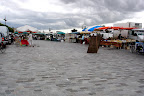
The souk (farmers’ market) here is something straight out of Europe. Every Saturday, just steps from our apartment, is a bona-fide organic market offering everything from fresh honey to knitwear to pickles to sandwiches. What is fresh honey, one might ask. The honey folks come with jars, honey in the comb, and a small hand-operated centrifuge. The honey is raw, and filtered through a strainer with only the occasional sunlight to help loosen it enough to pass through. There is labneh, a sort of goat milk yogurt/cheese that’s been rolled up into balls and dunked in the local olive oil, which will keep at room temperature. There are several women making fresh flatbreads (and sandwiches with them) of different sorts, using organic grains and age-old technique. The figs are phenomenal and only $1.33 per pound. The whole vibe is so laid-back and pleasant. Some of the prepared/preserved foods seem a bit expensive compared to local prices, but it’s striking how honest everybody is. No forgotten withheld change, no price-gouging for foreigners.

Beirut (I can’t speak to the rest of Lebanon—I haven’t been yet) challenges one’s preconceptions of Arabs. Bearded men are not spilling onto sidewalks during the call for prayer. Pizzerias offer prosciutto as a topping. I notice church bells as often as I do calls to prayer. When going out in the evening, the women dress to kill: not much different than being around a university on a Friday night. Some decent wines are produced in Lebanon, and the guidebook calls arak (an 80-proof, aniseed-flavored brandy relative) the national drink. French and English are spoken as much as is Arabic, making this an easy city to navigate as a tourist. The people, while typically so very warm and friendly, are not like many of the characters I encountered long ago in Morocco—here there is little to no badgering, begging, or cheating.

The climate here is spectacular. We live a short walk to the Mediterranean, and have the beautiful days and nights to prove it. Aside from the freak thunderstorms last week, it’s been a pretty steady 80F during the days, and perhaps 70F by night. The humidity quickly turns on my sweat glands faucets, but keeps our skin healthy. Sure, the summers get hot, but right now it’s absolutely gorgeous, and will probably remain so til Winter, when they’ll undergo a frost-free mild, but cooler winter.

Thursday, September 24

of german hospitality

As I fell asleep plugged into a saxy, airplane-supplied Branford Marsalis CD, I woke up courtesy of the captain’s PA come morning. The yogurt drink was all I dared try of the breakfast to-go offered by the flight crew. Besides, I was still working on the bag of pastries generously sent with me by my friend Nikola at Iggy’s bread.

Arrived in Frankfurt, we had a whole day to spend exploring. First stop: hot shower. It took us thirty minutes to find the well-hidden arrivals lounge, but it was a welcome place to put down our carry-drag-ons, clean up, and relax. The food was simple and welcome: perfectly-boiled eggs, olives, and soft cheeses, among others. A nearby baggage storage facility took our bags for the day as we went into town.

Note to the uninitiated: if two or more of you are going into the city for a day trip, splurge the extra euro on the Frankfurt Pass. It wasn’t even presented as an option to us, but would have saved us money later on our museum visit. We went first to the Staedel Museum and then onward to feed our grumbling stomachs. We walked down a long stretch of storefronts looking for the right place, occasionally asking the brusque locals for suggestions. We ate first at a chain-like though redeeming-looking currywurst joint, armed with an array of sausage-saucing squeeze bottles ranked from 1-10 based on the underlying chiles’ hotness. There was no redemption to the bratwurst we shared: it just wasn’t very great. Onward to greener pastures.

Wagner was our next (and final—I just can’t eat the way I used to in my youth) stop, where I started with my first taste of appelwine. Great beverage! Everything apple cider should be (and sadly usually isn’t), but without bubbles: funky, dry, acidic, appley. The meal that followed was, as a whole, good but not great. I did really enjoy the sauerkraut that came with the sausages.

Back to the airport, where we waited only a short while as we learned of our fate in Beirut and I helped myself to some bubbly.

In parting, another note to the uninitiated: if you

see a couple of sweaty folks lugging enough bags for four travelers when going through airport security, avoid that queue no matter how short it may seem. They’re going to take (and I quote from The Sandlot) for-ev-er.

Thursday, August 9

spain

This was not my first visit. My freshman college spring break, rather than gawking at drunk and uninhibited coeds on Daytona Beach, Florida, I came out to Spain and France (with three generations of Harper women) for a short trip along the Mediterranean. Those two days in Barcelona were my first, but I didn't appreciate them nearly as much as these (this time with my own family), nine years later.

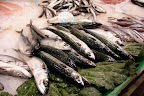
Unsurprisingly, this trip was about eating. The region is known for its food, and we discovered just why. We spent the first few days in Barcelona, then making for the Basque region along the northern fish at the market in Barcelona coast. We spent our few nights among Zaragoza, Bilbao, and San Sebastian, and dined in a handful of picturesque small towns along the way (detailed reviews to come). Zaragoza, where we simply rested the night, was bigger and livelier than expected. Bilbao seemed a fun place to end up to study abroad—a hip town with great museums . San Sebastian is a town for a couple of simple activities: beach going, and pintxo bar-hopping. Pintxos, the local term for tapas, are the force behind the region’s food scene. A late-night visit to one such local bar ran circles around (and was a tiny fraction of the price of) the three-starred restaurant from the night before.

I reminded myself why I hate driving in big European cities: traffic is awful, and it’s just as cheap and ever more convenient to use taxis. Once out of the city, as the designated navigator, I pulled out my hair trying to figure out why the motorways couldn’t be better-labeled: just give me a direction and a clear road name. Instead, we navigated twisty mountain back roads that called themselves one thing even though our directions told us another. We got there, but not without some yelling, frustration, and confusion.

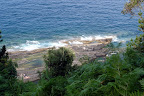
Still, if one is going to get lost avoiding the toll roads (about $75 in tolls for the six-hour drive from Bacelona to San Sebastian!), the mountainous region between Bilbao and San Sebastian is breathtaking. All is lush and green, and when it gets warm, the coast offers secluded cliff-backed beaches. Stopping to peer down to the view from the road to san sebastian rocky beach, I imagined an ideal summer afternoon: bathing in the cool water, eating jamon and drinking ocean-chilled beer and wine. Plans were for us to get some time on the beach in San Sebastian. The weather thought nothing of our plans: it scoffed, blowing cold air and raindrops our way, in the middle of July. Bygones: our time in Spain was quickly gone, and there would be plenty of time for the beach in Israel, our next stop.

Monday, July 30

bread and cheese to come

I'm not done writing up all of my French experiences, but in the spirit of keeping this blog at least somewhat up-to-date, I'll leave this as a placeholder, and promise to come back and fill it in. In the meantime, it's time to go on to Spain and Israel...

chers francophones

Chers tous mes amis français (ou francophones). D’abord, je suis désole de prendre si beaucoup de temps à vous écrire quelques choses. J’était avec ma famille toujours—j’était leur guide et traducteur. Alors, en addition d’avoir la (bonne) stresse d’être avec eux toujours, c’était moi qui avait les responsabilités de chercher les restaurants (naturellement), naviguer tous les petits chemins (pour voir un peu plus de la campagne et pour éviter les grands péages), et trouver des hôtels agréables. Evidemment, on n’avais pas de chance à faire des petites siestes, mais on à manger (sauf un ou deux repos) très très bien.

Je suis arrivé à Barcelone en retard (chacun de mes trois trains sont devenus plus en retard), et très fatigué d’avoir trainer mes 60kg de  bagages partout les gares qui je suis visité. Il restaient quelques petits morceaux de jambon et de chèvre, de melon et des fraises du frère de Papi. Ma sœur à commenté qu’ils étaient les meilleurs fraises qu’elle a déjà gouté. Normalement, il ne restaient plus de fraises.

On a mangé en plusieurs bons restaurants, et assez des bars de tapas (pintxos, comment ils s’appellent au pays Basque). Normalement, les meilleurs repos étaient aux restaurants plus simples et moins chers, mais il y avaient quelques hauts restaurants qui étaient aussi hyper bons que chers. En tout cas, les Basques ont de la vachement bonne cuisine. De plus, il est une région super belle : des belles plages, des bois, des jolies villes isolées. Est-ce que j’ai mentionné qu’on a mangé bien ? Quand quelqu’un est prêt à voyager là-bas, je serai très content de donner des noms et adresses des restaurants, etcetera. Dans les prochaines jours et semaines, je vais écrire quelques critiques dans mon blog.

Israël est vachement chaud, 35-40°, mais même très humide, alors, je deviens moelleux immédiatement quand je vais à l’extérieur. Je me suis bien amusé, et demain une copine va me rencontrer avant qu’on départ en Jordanie à plonger sur mer et explorer un peu. Et bien sûr que je mange (et mangerai) très bien. Ma famille a gouté et a aimé les fromages et viandes de Crozefond—particulièrement la pâté de ragondin (merci Vincent !).

Bon, il y a plusieurs des photos dans mon album et je vous invite a continuer de lire mon blog en anglais (vous savez qu’il faut pratiquer !), parce qu’il serais trop difficile de traduire tout en anglais… Vous me manquez trop. J’espère à vous visiter très bientôt. Passez mes saluts à Mami et Papi, les enfants, Vicky et Spot, et tous les autres qui je manque. Pensez de moi de temps en temps, comme je pense de vous, et m’envoyer des nouvelles quand vous avez des fois.

Sunday, July 22

going to market

The weekly markets are butter to Crozefond’s bread. No fewer than three weekly markets are attended during the warmer months. The markets begin at Villeneuve-sur-lot on Wednesday morning. The marathon continues Thursday morning at Bordeaux before climaxing at an evening market on the way back to the farm Thursday night. Each market has its distinct dynamics.

Thirty minutes away from the farm, at Villeneuve, Mami and Regine lend a feminine sensibility together with a couple of the granddaughters. The market (what few minutes I experienced) has an altogether laid-back feel, though it has a fair number of producers. Papi’s brother, along with several other produce stands, sell fruit and vegetables. There’s a guy who makes great chevre (goat cheese), a fishmonger (if I remember correctly), and the occasional staples-peddler (salts, vinegars, etc).

Bordeaux is a much larger town, and is three hours away (meaning  getting up at 3:45 to load up the cold goods and get the camion rolling). This market, at least when stagiares are around, has a different, more intense feel, even with fewer vendors. Bordeaux is where Vincent tends to take the stagiares, and is the market I became most familiar with. It’s full of characters. Before we’ve even arrived, groupies are gathered at our parking spot. Sweet arthritic women and flamboyant old men know the stand’s workings better than do the stagiares, and get down and dirty helping us set up. They do this for nothing tangible in return. Julie, a psychology student at Bordeaux, works weekly to earn some extra euros. She’s quick on her toes: she seems comfortable dancing around the occasional harmless chauvinistic banter.

Then there’s her occasional patient-to-be, like Chella, who announced her distaste for Americans upon meeting me. When she learned my ethnic background she tried to redeem herself, but ultimately seemed confused that I consider myself an Israeli despite Arab roots. The next week, before any greetings or pleasantries, she chastised me for improperly returning her bicycle after borrowing the previous week. It turns out I left the seat lowered (my fault, yes, though the quick-release fastener should have rendered the adjustment easy as riding a bike) and for breaking her brakes (this one an unfounded accusation). Alas, some people, one learns, are best just left alone.

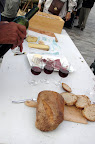
At 10:30am, our halfway point, we join forces with the winemakers to our side and set up a snack table behind the scenes. Wine glasses fill up, bread sliced, cheese and ham brought out. A couple of bicycle-mounted policemen and -women are regulars, but mostly older men show up, talk trash (in French the expression literally translates to “make the mayonnaise”), and get their morning buzz on. It’s very convivial, and poles apart from anything we’ll ever see at the Union Square market. Around two o’clock, we eat again, picking at leftover pizzas and quiches, rinsing with more wine (or coffee). Then we pack up and head to the second market of the day—an evening market complete with entertainment, booze, and lots more to eat.

Having spent the last twelve hours on the road and at the market earns one the privilege of relaxing a bit—walking around and sampling the fare. Mami introduced me to her cousins and various townsfolk. I chatted a fair bit with Serge, the mayor of Savignac who, along with the Pozzers, is entertaining and entertained by the possibility of me someday settling down in the area (have I mentioned I love it here?). There’s altogether too much food to go around. Working with one of the vendors has its privileges, such as grilled skewers of foie gras-studded duck breast, and pretty much all the wine one can drink. The British invasion in the area makes for a number of people with whom to practice my native tongue. And there’s the evening show—sometimes rock, sometimes rather awful folky stuff. Turnout reaches 1000 on busy weeks, creating another amazing scene that brings out my American’s jealousy. All of this is picturesquely set on the Lot river, and brings one to dream of living on its bank (Mami’s keeping her eyes out for a suitable piece of land for me).

At midnight commences a communal drunken chair-stacking, table-dragging orgy. We finally make it to sleep, a full twenty two hours after waking for the long day.

Tuesday, July 10

fires and booze

Since arriving, by my count (even counting sometimes gets fuzzy) I’ve attended four outings, for lack of a better term. Two were for St Jean’s day, two were festivals local to southwest France, called Bodegas.

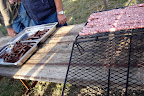
St Jean’s day technically falls on June 24th, but is celebrated whenever the local towns decide to celebrate it. I’m hopefully not stepping on too many Catholic toes by calling it a pretty pagan celebration. I compare it to Sweden’s similar bonfire holiday in late June. St Jean’s has the obvious religious connotation; Sweden’s is pretty outwardly-traditional/pagan. In any case, as it goes, it involves food (whether as simple as Savignac’s sausage grillade or as elaborate as St Aubin’s more intricate plate including pâté, grilled pork, veggie sides, and dessert), followed by a bonfire at nightfall (a late 23:30 at this time of year). St Aubin’s was rather tame while Savignac’s (Vincent’s) left me with a headache the next morning. Vincent corralled us up for the walk to his house, where he broke out his own pear eau-de-vie, prunes soaked in armagnac, along with a medley of beers and cognac. A cool bit of slang I learned for the post-drinking phenomenon (it sounds cooler in French than in English) literally translates into a “hair ache,” or “my hair is growing inward.”

Bodegas are an altogether different beast. The term is Spanish, but it refers to a township’s summer block party, if you will. Like the bonfires, they range from a smallish couple-hundred people dancing to bad ‘90s remixes and eating mediocre food (as we did outside of Monflanquin, to the much larger summer spectacular we at Issigeac (Bendicte’s hometown). Here, we started off with a hearty white bean soup slowly stewed with lots of pork skin, moved on to crepes stuffed with sautéed onions, crème fraiche, and ham, followed by a grilled brochette of duck breast. There’s no shortage of beer on tap and very drinkable box wine sold for less than a coke (1 euro). Throughout, we grooved to various bands playing throughout the picturesque village, from French marching band to contemporary French fare to a good blues cover band.

In any case, small or large, elaborate or simple, I can only think of one event I’ve attended (alas, I wanted to USA-bash with an honest zero) in the States that would begin to match the experience: Danny Meyer’s Madison Square Park BBQ spectacular (the queues are ridonculous (sic), but the food is outstanding). Seems it’s time for me to hit up some real southern BBQ fairs…

a bit of the bayou

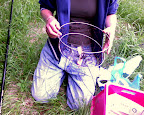
We went crayfishing the other day. Armed with traps that reminded me more of hanging fruit baskets for the kitchen, we’d strategically (read: right side up, in the water) set them down in the muddy stream, wait a few minutes, and then pull them back onto land. The  traps being little more than glorified nets, it was key to get it out of the water and onto land before the big bugs would crawl through the net and back to safety. We baited with some old sardines Claudette had in the freezer along with special crayfish (écrevisse) snacks (read: not-so-slim dry blood sausage slim jims). The little buggers preferred what probably more natural to them: the sardines (or maybe it had something to do with the snackies not being organic).
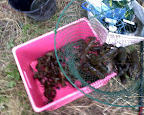
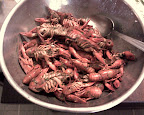
We were worried at first that it’d go the way of my flopped turkey  hunt last fall (no turkeys in sight, thanks), but after a few empty nets we caught onto their game, and ended up with something like 80 of the American guys (turns out they’re not native: they’re a pest that somehow got transplanted at some point—the better, I’m told, native crustaceans of bigger rivers are only allowed to be hunted one day each year). Cleaning them meant carefully grabbing the body with one hand (careful not to lose a finger in their pinching claws), and pulling out their middle tail-fin, vein (and digestive waste) included. Cooking them was deliciously straightforward: a hard sear, ample garlic and parsley, and a flambé of Vincent’s prune (plum) eau de vie (literally: water of life, really: fire water). They yield even less than Maryland blue crabs, so you need to be prepared with a patient appetite and to make use of the guts, not just the tails. There were lots of mosquitoes and thorns about, but a hyper- (as they say around here) fun time.