Showing posts with label excursion. Show all posts

Sunday, December 6

lightning round, nagar style (2/2)

Wednesday evening we drove to Novi Sad for part business dinner for Vlad, and part fun dinner out for us and his girlfriend, Jelena. Though it was technically a day early, we drank Beaujolais Nouveau along with a local equivalent: Portugizer. Both were equally drinkable, though nothing exciting, as is to be expected. After a long, drawn out dinner with few exceptional dishes, we drove to our cute bed and breakfast, a farmstead of sorts, called Salaš 137. Their main attraction at the Salaš is horseback riding and golf. As we arrived quite late, we went straight to our rooms: swelteringly hot thanks to the warm weather and wood-fired stove in each room, but really quite charming. The morning was another lazy one.

The reception lady asked if we’d like to ride horses, I was the sole taker: why not? After waiting around the horse track for the trainer for what seemed like forever, a man finally walked up with a horse. I should follow him, he indicated through pantomime and broken English. We went to the horse run behind the stables, not the horse track where others were riding. Fine, no problem by me, I wouldn’t have to look like a silly novice in front of strangers. I got on the horse, which is about when I realized the trainer must have been told I was a complete moron. He told me to hold on, and took the reins himself and walked the horse around the run a couple of times. We chatted about his fear of flying, and places he liked visiting in Europe. I asked him the name of the horse, Bellissima, and was about to ask if I could take the reins myself and show Bellissima what a real cowboy from the wild west can do. I never got the chance: as I began to speak, not five minutes into my horse ride for toddlers, the man told me to dismount and go back to the reception desk to pay for my ride. Wow—pay for what, I wondered… The reception lady was surprised to see me so soon, and asked if I’d seen the trainer. I told her about my ride, and she looked as mortified as I felt like a special needs child. Good times.

We high-tailed it back to Belgrade; we had tickets for the evening’s game between the two local basketball clubs: Partizan vs. Red Star. The two have a serious rivalry, and I wanted my family to experience sports enthusiasm at its height. We first ate dinner at Zaplet, and were waiting to leave for the game when I noticed on the downstairs TV that a game was on. Our game. Almost halftime. I have not been a model of punctuality in Serbia, and this evening was no exception. We quickly took a cab to the stadium. Only, the language barrier brought us to the wrong Partizan arena. I showed the driver the physical tickets, and we were again on our way. The driver asked if we’d been to a game, wanted to make sure we knew the dangers. Way to heighten the suspense… The suspense and anxiety were largely for naught: the Serbian church patriarch died days prior, and the funeral was the day of the game. Not only that, but fearing the worst of the fans, the game’s attendance was limited. Though our team lost, it was a good game. We sat between two friends who obviously rooted for opposite teams, at one point nearly ending up in the middle of a fight. Good times.

And that was that. They left as quickly as they came, and were enchanted by the country and its people: they already want to return. This place has that effect on people. In their place, they left goodies Vlad and I had ordered for the kitchen, including some of Taza Chocolates finest specimens (thanks go to my friend Alex for getting together the order on short notice—if you haven’t tried their stuff, you should: I’m willing to bet that it will pose a hefty and worthwhile challenge to your concept of chocolate). They left behind books, knives, and lots of love. A special thanks to all who made the week such a great time, most of whom will probably never read this.

Tuesday, November 24

lightning round, nagar style (1/2)

I have had no time for writing of any kind this past week. Work gave way to my family’s arrival ten days ago, and I was destined for the role of tour guide extraordinaire. They arrived without their luggage, a frequent occurrence in these parts, it turns out. Their airline, however, was kind enough to give them some spending cash to compensate. Cash in-hand, with them I was finally able to explore some of the Serbia I have been too busy to see. Here is part I of a brief recap, to the best of my memory.

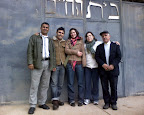
We spent the first couple of days getting acquainted with Belgrade proper: a trip to Kalamegdan fortress (a simply beautiful place to stroll around), a walk down the pedestrian-zoned downtown Knez Mihailova street (shop til you drop—literally: you’ll faint at the high prices on anything produced outside of Serbia), a visit to the Jewish History Museum (enlightening) followed by a look inside the only operating synagogue in Belgrade. The weather was highly cooperative—mostly sunny, usually warm enough to eschew heavy coats. We visited some new (to me) restaurants. For the sake of documentation, Lovac, a game restaurant, was largely a disappointment. Šaran, however, an old fish restaurant in the old neighborhood of Zemun, was great. Zaplet (where I work) was the overall favorite, my mom especially enjoying traditional food that reminded her of what she ate as a child in Israel.

Unable, at the last minute, to join us on a trip to Mokra Gora, Vladimir instead arranged for us be driven in a friend’s car. An amazingly generous and ridiculous gesture, an extremely polite man by the name of Ivan drove. Since Shiri, Viktor, and I had gone out late the night before, I was in and out of consciousness for the spectacular drive. The landscape was stunningly beautiful and we drove by numerous small towns and through thousands of acres of farmland. The trip was largely an excuse to relax and be away from the bustling city. We arrived and started a fire in our cozy wood cabin. We napped, ate, and talked about various business and investment ideas (typical Nagar conversation). It was nice to sleep a bit and we all enjoyed exploring the surroundings, hiking down the hill to a nearby village in search of a fabled farmers’ market we had been told to visit, but could not find. So we began the lazy return to Belgrade.

We stopped in Užice to visit its farmers’ market. There, we found some great kajmak and fresh goat cheese from a man selling a variety of dairy and smoked meats. We also stocked up on apples and pears, buying some homemade wine from the same woman. Yes, homemade wine, at an open-air market. Homemade wine sold in a variety of old soft drink bottles. Did I mention I love this country and its lack of regulations? Where else can you buy this kind of stuff? Onward, we stopped at a floating restaurant on the bank of a river. Old men fished from the restaurant’s patio and from nearby boats. Sadly, though the fish was ostensibly fresh, grilled really meant deep-fried to an overcooked dark brown. Indicative of the relaxed Serbian mentality, the wine I had ordered upon first sitting arrived toward the end of our hands-on fish eating contest. Since we were going to have the main course on down the road, we sent it back and got the check instead. The next place was a nondescript house marked with nothing but its address. Ivan heard about it from a friend who lived nearby, and it served only traditional Serbian style veal breast, slowly roasted. An excellent main course, though quite too much food, as usual. Judging by the shape of the car when we returned, Ivan managed to remain awake for the rest of the drive back; none of us were so successful.

Stay tuned for the second part of this exciting tale!

Tuesday, November 10

butchering buša

Though I have experience butchering small livestock, before last week I had never really done any in-depth butchery with beef or veal. Last month, knowing that we would have the opportunity to work with less common animals such as Mangalitsa pigs and Buša cows, I sought out advice on the best uses for their various parts. Mangalitsa pigs turned out to be well-documented thanks in large part to Heath’s efforts at Wooly Pigs’ in Washington state. Buša cows are another story entirely—searching several permutations of the name turned up next to nothing, besides some very basic technical information about the breed. At one point, though, I found an email address for a man named Zoran, listed as the Buša breeding contact in Serbia. I wasted no time getting in touch with him, and he was quick to respond to my inquiries. Not only did he give me further information about the Buša cows, but it turns out he raises Mangalitsa pigs as well.

It seems that Buša were traditionally raised by subsistence farmers in the mountains where the milk, rather than the meat, was the primary product. As such, the cows would typically be slaughtered at an age approaching 15 years—resulting in meat more suitable to braises and stews than anything else. In any case, Zoran promised to be in touch when the time approached to slaughter one of his animals.

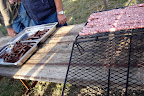
Last week, as promised, he wrote me of a Friday slaughter of his Buša bull, 1.5 years old. I quickly replied, and we agreed that Vlad and I would drive out to their town of Vršac to see whatever we could. As the slaughter was early in the morning, we skipped it and instead drove straight to his house, where we were invited in to meet his beautiful family as well as his butcher of 50 years’ experience. This was indeed a family affair, attended by his wife and two engaging children, as well as his mother and father. The butcher, in a fashion I’ve never before experienced, had meat spread out across the wooden dining table, using a small cutting board to do the work.

I cannot say enough good things about the experience. It just struck me as the right way to approach the meat we eat. Here were two young kids, playing with the bones, watching the butcher at work, and helping to take the meat upstairs (where it would be laid out on the floor to rest overnight before being frozen or further processed/cooked the next day). Zoran gave us tastes of his friend’s acacia honey, his father’s two year old bacon, the last of the season local grapes, some grassy fresh goat cheese, and his own unfiltered apple cider. Zoran’s wife, a physician, told us of the healthy nature of the Buša’s omega-rich fats, pointing out bone marrow (love it) and fatty cuts, mentioning the liver as especially beneficial to the kids, with its concentration of iron and vitamins. The event seemed straight out of Barbara Kingsolver’s Animal, Vegetable, Miracle (I recently finished reading it).

While we came for ideas in using the veal we had at Zaplet, we left instead with a warm fuzzy optimistic feeling about family and life. And death: the butcher went on to show us how he kills the animals, with a purposefully-designed gun made by none other than F. Dick, better known for their utilitarian knives. We had to run back to Belgrade before the family had a chance to put me to use in the kitchen, but they have an open invitation at Zaplet. I look forward to our next encounter, and hope that I can provide as well for my future kids.

Monday, November 9

nice hams

Sunday night I went for a ‘quick drink’ with Viktor, and almost made it out of Scandal by 1:30. Viktor said ‘one more,’ and I took the bait. Having finished, the server delivered another round, this time on the house. Again, we drank and almost exited, but the Karaoke band said they’d sing another song before calling it quits for the night, and so we of course stayed. Once again, I found myself falling asleep at 4:00, usually not a problem on a Sunday night. I had to meet Vlad at nine, though—we had an excursion planned to visit one of Serbia’s best Prosciutto makers.

Zombie-like, I trudged up the street to our rendezvous point. I, the dwarf American, moved quickly to the back seat when we picked up Vlad’s friend Dragan, a former basketball star—even in the front seat, his knees were up against the dashboard. We chatted and talked about the sights on the way. About halfway through our drive we stopped at a café on the road. Inside was a scene out of an old detective movie, sunlight pouring through thick, smoky air atop red-checkered tablecloths. The large space was occupied by but three old men passing the time. One of them got up and took our order, hot tea for me. Our drinks arrived, and I sipped my Serbian tea—Vladimir had modified my order. No, the Serbs don’t grow tea high up in their mountains; Serbian tea is hot sweetened Šlivovic (plum brandy). Still before noon and slightly buzzed, I picked up a few fallen pears by a well-endowed tree—they’d make good post pork snacks.

We were met by a lead car for the last confusing yet beautiful countryside stretch of road to Mirko’s pršut (prosciutto) plant. The building that houses the prosciutto works is quaint and sparse. We were led on a tour through the wing where the magic happens, up on rafters above the ground floor where a fire pit is used for some gentle smoking a few days each year. Mirko hails from the Dalmatian coast of Croatia, where he first learned his craft in a much more Italian tradition. He searched long and hard for land with just the right year-round breeze and climate, settling finally in the hills of Cajetina. The clean country air rarely climbs above 20°C, making it an ideal spot for this venture.

The extent of our hours-long stay at the house that was translated to English can be summed up in this one paragraph; I did ask lots of questions, but Serbs love to talk, so by the time my question received a long-winded answer, it was either forgotten or just lost in the transition to a tangent. The hams are first salted for several days before being rinsed and again salted, this time pressed between layers of wooden planks for several weeks. They are then finally hung up to begin the two-year drying process, with the occasional waft of smoke (most Serbian pršut is very heavily smoked) and a constant breeze through the windows. They get coated with chalk dust in three monthly stages beginning in April of their first year, first the area where exposed bone meets meat, followed by where skin meets meat, and then finally coating the entirety of the ham. When ready for consumption they are rinsed of the protective coating and packaged as required.

Mirko, at the behest of the German laboratory who tested his products, has begun to experiment with hams that are not smoked at all, and is slowly phasing out smoked products altogether. Still, even his smoked pršut is hardly so. We were invited to sit down to a tasting of all his products, beginning with the obligatory brandy before moving on to a homemade entirely refreshing white wine. Ravenous, we travelers dined with vigor hardly surpassed even by the fabled Oliver Twist. The prosciutto was well-made, but salty to a fault. The pancetta (cured bacon, really), however, was on point and worth every calorie. The culin (a regional smoked sausage spiced with paprika and rather similar to Spain’s chorizo) was very good, though might have actually benefited from some of the ham’s extra salt.

We nearly ate the platter bare before Mirko quietly snuck out to slice another entirely unnecessary round. We broke out more wine to accompany the excess meat, and satiated quickly went the way of bursting. I, frustrated by my lack of ability to understand more than the occasional word, took to the wine with gusto to be sure to completely dehydrate my over- yet still malnourished body. The wine coupled with my lack of rest culminated in my neck going floppy for the three hour ride to Belgrade. Though I slept the whole way, my neck was sore from all the turns. The illness I felt was reminiscent of my binge on wild plums at Crozefond years ago, though this one was decidedly less healthy-feeling. Killer pigs reigned in my dreams that night.

Tuesday, October 13

of hairy pigs and bloody butchers

On Sunday Vlad and I awoke early to drive to his friend Milu’s home in the hills near Belgrade. There was a special event: this was the morning one of his prized mangalitsa pigs would be slaughtered and we, at the restaurant, would help prepare and preserve a fair part of it. Sadly we were not early enough: by the time we arrived the blood was already spilled, the pig skinned, and mostly hacked into individual portions. We

managed to salvage a bone-in (but skin/fat-off) loin, a leg and the skinless jowls. The rest that we took with us was already cut into pieces. So, after much stress about nothing, I realized I need not have worried about it: the parts we had left would dictate their own uses. The scrap and leg, I marinated and made into rillettes and sausage (much of it destined for Milu’s freezer). I’ll use some of the jowls’ fat to enrich the sausage, as much of the fat had been trimmed. The loin, we will roast whole tomorrow for Milu and his party of fifteen. The rest of the jowl, we haven’t figured out yet; hopefully tomorrow.

Milu, an investment banker and lover of food, has taken it upon himself to save some of the Balkans’ rarer breeds. He has a herd of indigenous Buša (pronounced: boosha) cows, a breed that is full-grown at 200kg and will eat grass throughout the winter, digging up to a meter in the snow to find vegetation food. He has sheep and goats that are nearly extinct (I lack the details on their breeds).

Both sexes of the sheep grow long horns. And there are, of course, the mangalitsa pigs, one of the most primitive swine family members, with a short, stocky body, and hairy coiffeur (generally dark brown, though I took pictures of a couple he has that are blonde—a recessive gene, Milu explained). These pigs are suited for charcuterie, with 3:1 ratio of fat to meat, I’m told. I really admire what he’s done (though I did not see most of the animals, as they’re tucked away on a mountainside pasture he has purchased to raise them), and we talked for a bit about the logistics (and challenges) of harvesting and selling some of his livestock. Serbia, it turns out, might not be ready for these fancy animals, as they likely would not fetch their true value on the market, so for now, he continues to grow the herds rather than harvesting animals.

In any case, we made the best of our time up in the hills. I had a chance to meet some of Milu’s animals: long-haired mangalitsa pigs, geese, chickens, and turkeys. I ate fruit fresh off his pear and fig trees, and ate the four raspberries I spied desiccating on the vine. We sampled their tomatoes and grapes, and I marveled at their beautiful abode just up the hill from the mini farm/in-laws’ house.

Their home is beautiful: an old 18th century home transplanted from an old village in Serbia and added onto with some modern touches, yet keeping its vintage charm in the first floor sitting room (photos to come). His wife Mila taught me her ajvar recipe (more on this fantastic food to come in a separate post), as I loved her version, and we drank green tea while snacking on their fruit preserves (straight out of Christine Ferber’s great book, Mes Confitures).

Back at the farm we picked up our still-warm pork, but not before gorging ourselves on the cracklings left from the lard that had been rendering over a wood fire all morning. This country is great. We’ll be returning at the end of November to slaughter four more pigs, this time with more planning, and hopefully some prosciutto by the end of next year if all goes well… In any case, I left mesmerized (and on my way to a full blown cold, which I love complaining about; no shock to those of you who know me), with a new slow food hero to add to my list of people I admire.

Coming soon: I’m officially a tv star and the truth behind wonderful, mystical ajvar!

Sunday, October 4

onward bound!

I’m falling seriously behind on blogging, and heard of some anticipation today. That’s flattering, really: I’m glad some of you out there are getting a kick out of this—I welcome and savor comments and personal notes, so be in touch!

I had been meaning to write my last couple of Beirut posts during the twelve hours of travel time I’d have on my way to Belgrade. Obviously that never happened, so the nutshell long version (to be accompanied shortly by photos): four of us (EB, her friend Sammy, visiting from Egypt, Smuggler, and I) piled into EB’s new car for a road trip. We had each looked at maps and guides and come to similar conclusions. There were three main agendas: hike through some nature, visit a winery, and eat dinner before sundown (I fast for Yom Kippur, and it began the evening of our road trip).

We arrived at a small town by a nature reserve feeling rather famished. The ladies ransacked the packaged goods section at a small grocery, and while EB wasn’t looking, I ran off in search of fresh food. Noon was early for lunch, and quick food was surprisingly hard to find given the bustle of people. I avoided the sickly looking schawarma that looked suspiciously dated, and happened upon a man grilling chickens over charcoal. Some puffy bread from next door in-hand, I ran (literally) back to the car to avoid a confrontation over schedules and delays.

We had trouble finding the site, and stopped to ask directions from a man on the street. He turned to his friend, who had just parked his car, when he heard the American accents. So this delightfully cheerful chap greeted us in the most unexpected Australian accent. Not only that, but he got back in the car, and happily led us the fifteen minutes to the site, parting ways as he told us to follow a mysterious dirt road for ten more minutes.

Guidebook moment: it turns out there’s a nearby town in Lebanon that exported many of its finest citizens to Australia during the civil war. Many have since made their way back, and begun importing Australian foodstuffs.

We ate lunch out of the car’s rear under hot sunshine before departing on a two hour hike through beautiful terrain varied with chaparral and cedar woods. I must have tasted a dozen of the wild yellow plums I found occasionally in the dirt before finding one whose sour and bitter notes did not contort my face.

The drive onward to the Bekaa valley for wine tasting and dinner was long and arduous. When planning trips involving mountains and valleys in developing countries, it certainly pays to consider the elevation changes. We went from 1500m down to sea level, only to climb a rocky peak to its peak of 3000m before descending into predominantly Hezbollah territory (Nasrallah is a man of god, and loves his people, the billboards declare). The estimated one hour trip? More than three, it turned out. The winery was surely closed (boo hoo), and the sun was descending ever faster, but we made it to our feeding spot in time for my pre-fasting food fest.

Smuggler parted the sea of pedestrians as we walked to the river-side casino restaurant (Mehanna, in case you’re ever in the area). They were surprisingly accommodating, allowing Smuggler to sit with us (outdoor seating, but still amazing for this dog-fearing country), and even bringing a dish ashtray of water for him. The mezes we tucked into were outstanding, and we hurried out to wait in awful lung-wrecking traffic for the ride back to Beirut.

As I began my fast-culminating meal of leftovers the next night, I noticed a noise coming from the washing machine that EB had just started. It’s moments like these that remind you to hate on America’s litigious society for imposing door locks on washers, for EB had spied her IPod tumbling from behind the glass door. The MacGyver in me came out as I got the door open and quickly set upon fixing the problem. Lacking the proper tools, I used my semi-disposable paring knife to pry open the dripping music box. Into a warm oven went the disassembled machine, and to the airport went I, stomach beginning to churn.

The 3:10am flight was fine, though I’d spent some time chasing my tail in the airport, thinking I had lost stuff that was with me all along. I carried 20kg on my shoulders since my suitcase was overweight and the flight agent was strict (of course I was surreptitiously over the limit on my carry-ons). As my digestive functions were quickly deteriorating, I found myself chilled, achy, and unable to get any real sleep. The airport lounge (thank you, Diner’s Club) in Prague, where I stopped for five hours, allowed me a hot shower, snacks, and internet connectivity, but I was too out of it to take advantage. So I made way for Belgrade, seeing bathrooms in the light that had coined the term “pit stop.”

And here I was, thinking that I would actually be writing about my first few days in Belgrade. When I was younger and creative writing assignments were due I would have killed for this sort of verbal dysentery. I do apologize for the lack of editing, though one must realize this ailment is messy.

Thursday, September 24

of german hospitality

As I fell asleep plugged into a saxy, airplane-supplied Branford Marsalis CD, I woke up courtesy of the captain’s PA come morning. The yogurt drink was all I dared try of the breakfast to-go offered by the flight crew. Besides, I was still working on the bag of pastries generously sent with me by my friend Nikola at Iggy’s bread.

Arrived in Frankfurt, we had a whole day to spend exploring. First stop: hot shower. It took us thirty minutes to find the well-hidden arrivals lounge, but it was a welcome place to put down our carry-drag-ons, clean up, and relax. The food was simple and welcome: perfectly-boiled eggs, olives, and soft cheeses, among others. A nearby baggage storage facility took our bags for the day as we went into town.

Note to the uninitiated: if two or more of you are going into the city for a day trip, splurge the extra euro on the Frankfurt Pass. It wasn’t even presented as an option to us, but would have saved us money later on our museum visit. We went first to the Staedel Museum and then onward to feed our grumbling stomachs. We walked down a long stretch of storefronts looking for the right place, occasionally asking the brusque locals for suggestions. We ate first at a chain-like though redeeming-looking currywurst joint, armed with an array of sausage-saucing squeeze bottles ranked from 1-10 based on the underlying chiles’ hotness. There was no redemption to the bratwurst we shared: it just wasn’t very great. Onward to greener pastures.

Wagner was our next (and final—I just can’t eat the way I used to in my youth) stop, where I started with my first taste of appelwine. Great beverage! Everything apple cider should be (and sadly usually isn’t), but without bubbles: funky, dry, acidic, appley. The meal that followed was, as a whole, good but not great. I did really enjoy the sauerkraut that came with the sausages.

Back to the airport, where we waited only a short while as we learned of our fate in Beirut and I helped myself to some bubbly.

In parting, another note to the uninitiated: if you

see a couple of sweaty folks lugging enough bags for four travelers when going through airport security, avoid that queue no matter how short it may seem. They’re going to take (and I quote from The Sandlot) for-ev-er.

Thursday, August 9

spain

This was not my first visit. My freshman college spring break, rather than gawking at drunk and uninhibited coeds on Daytona Beach, Florida, I came out to Spain and France (with three generations of Harper women) for a short trip along the Mediterranean. Those two days in Barcelona were my first, but I didn't appreciate them nearly as much as these (this time with my own family), nine years later.

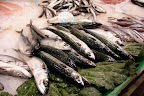
Unsurprisingly, this trip was about eating. The region is known for its food, and we discovered just why. We spent the first few days in Barcelona, then making for the Basque region along the northern fish at the market in Barcelona coast. We spent our few nights among Zaragoza, Bilbao, and San Sebastian, and dined in a handful of picturesque small towns along the way (detailed reviews to come). Zaragoza, where we simply rested the night, was bigger and livelier than expected. Bilbao seemed a fun place to end up to study abroad—a hip town with great museums . San Sebastian is a town for a couple of simple activities: beach going, and pintxo bar-hopping. Pintxos, the local term for tapas, are the force behind the region’s food scene. A late-night visit to one such local bar ran circles around (and was a tiny fraction of the price of) the three-starred restaurant from the night before.

I reminded myself why I hate driving in big European cities: traffic is awful, and it’s just as cheap and ever more convenient to use taxis. Once out of the city, as the designated navigator, I pulled out my hair trying to figure out why the motorways couldn’t be better-labeled: just give me a direction and a clear road name. Instead, we navigated twisty mountain back roads that called themselves one thing even though our directions told us another. We got there, but not without some yelling, frustration, and confusion.

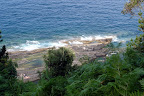
Still, if one is going to get lost avoiding the toll roads (about $75 in tolls for the six-hour drive from Bacelona to San Sebastian!), the mountainous region between Bilbao and San Sebastian is breathtaking. All is lush and green, and when it gets warm, the coast offers secluded cliff-backed beaches. Stopping to peer down to the view from the road to san sebastian rocky beach, I imagined an ideal summer afternoon: bathing in the cool water, eating jamon and drinking ocean-chilled beer and wine. Plans were for us to get some time on the beach in San Sebastian. The weather thought nothing of our plans: it scoffed, blowing cold air and raindrops our way, in the middle of July. Bygones: our time in Spain was quickly gone, and there would be plenty of time for the beach in Israel, our next stop.

Sunday, July 22

going to market

The weekly markets are butter to Crozefond’s bread. No fewer than three weekly markets are attended during the warmer months. The markets begin at Villeneuve-sur-lot on Wednesday morning. The marathon continues Thursday morning at Bordeaux before climaxing at an evening market on the way back to the farm Thursday night. Each market has its distinct dynamics.

Thirty minutes away from the farm, at Villeneuve, Mami and Regine lend a feminine sensibility together with a couple of the granddaughters. The market (what few minutes I experienced) has an altogether laid-back feel, though it has a fair number of producers. Papi’s brother, along with several other produce stands, sell fruit and vegetables. There’s a guy who makes great chevre (goat cheese), a fishmonger (if I remember correctly), and the occasional staples-peddler (salts, vinegars, etc).

Bordeaux is a much larger town, and is three hours away (meaning  getting up at 3:45 to load up the cold goods and get the camion rolling). This market, at least when stagiares are around, has a different, more intense feel, even with fewer vendors. Bordeaux is where Vincent tends to take the stagiares, and is the market I became most familiar with. It’s full of characters. Before we’ve even arrived, groupies are gathered at our parking spot. Sweet arthritic women and flamboyant old men know the stand’s workings better than do the stagiares, and get down and dirty helping us set up. They do this for nothing tangible in return. Julie, a psychology student at Bordeaux, works weekly to earn some extra euros. She’s quick on her toes: she seems comfortable dancing around the occasional harmless chauvinistic banter.

Then there’s her occasional patient-to-be, like Chella, who announced her distaste for Americans upon meeting me. When she learned my ethnic background she tried to redeem herself, but ultimately seemed confused that I consider myself an Israeli despite Arab roots. The next week, before any greetings or pleasantries, she chastised me for improperly returning her bicycle after borrowing the previous week. It turns out I left the seat lowered (my fault, yes, though the quick-release fastener should have rendered the adjustment easy as riding a bike) and for breaking her brakes (this one an unfounded accusation). Alas, some people, one learns, are best just left alone.

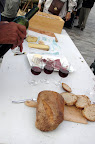
At 10:30am, our halfway point, we join forces with the winemakers to our side and set up a snack table behind the scenes. Wine glasses fill up, bread sliced, cheese and ham brought out. A couple of bicycle-mounted policemen and -women are regulars, but mostly older men show up, talk trash (in French the expression literally translates to “make the mayonnaise”), and get their morning buzz on. It’s very convivial, and poles apart from anything we’ll ever see at the Union Square market. Around two o’clock, we eat again, picking at leftover pizzas and quiches, rinsing with more wine (or coffee). Then we pack up and head to the second market of the day—an evening market complete with entertainment, booze, and lots more to eat.

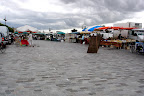
Having spent the last twelve hours on the road and at the market earns one the privilege of relaxing a bit—walking around and sampling the fare. Mami introduced me to her cousins and various townsfolk. I chatted a fair bit with Serge, the mayor of Savignac who, along with the Pozzers, is entertaining and entertained by the possibility of me someday settling down in the area (have I mentioned I love it here?). There’s altogether too much food to go around. Working with one of the vendors has its privileges, such as grilled skewers of foie gras-studded duck breast, and pretty much all the wine one can drink. The British invasion in the area makes for a number of people with whom to practice my native tongue. And there’s the evening show—sometimes rock, sometimes rather awful folky stuff. Turnout reaches 1000 on busy weeks, creating another amazing scene that brings out my American’s jealousy. All of this is picturesquely set on the Lot river, and brings one to dream of living on its bank (Mami’s keeping her eyes out for a suitable piece of land for me).

At midnight commences a communal drunken chair-stacking, table-dragging orgy. We finally make it to sleep, a full twenty two hours after waking for the long day.

Tuesday, July 10

fires and booze

Since arriving, by my count (even counting sometimes gets fuzzy) I’ve attended four outings, for lack of a better term. Two were for St Jean’s day, two were festivals local to southwest France, called Bodegas.

St Jean’s day technically falls on June 24th, but is celebrated whenever the local towns decide to celebrate it. I’m hopefully not stepping on too many Catholic toes by calling it a pretty pagan celebration. I compare it to Sweden’s similar bonfire holiday in late June. St Jean’s has the obvious religious connotation; Sweden’s is pretty outwardly-traditional/pagan. In any case, as it goes, it involves food (whether as simple as Savignac’s sausage grillade or as elaborate as St Aubin’s more intricate plate including pâté, grilled pork, veggie sides, and dessert), followed by a bonfire at nightfall (a late 23:30 at this time of year). St Aubin’s was rather tame while Savignac’s (Vincent’s) left me with a headache the next morning. Vincent corralled us up for the walk to his house, where he broke out his own pear eau-de-vie, prunes soaked in armagnac, along with a medley of beers and cognac. A cool bit of slang I learned for the post-drinking phenomenon (it sounds cooler in French than in English) literally translates into a “hair ache,” or “my hair is growing inward.”
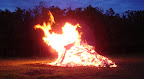
Bodegas are an altogether different beast. The term is Spanish, but it refers to a township’s summer block party, if you will. Like the bonfires, they range from a smallish couple-hundred people dancing to bad ‘90s remixes and eating mediocre food (as we did outside of Monflanquin, to the much larger summer spectacular we at Issigeac (Bendicte’s hometown). Here, we started off with a hearty white bean soup slowly stewed with lots of pork skin, moved on to crepes stuffed with sautéed onions, crème fraiche, and ham, followed by a grilled brochette of duck breast. There’s no shortage of beer on tap and very drinkable box wine sold for less than a coke (1 euro). Throughout, we grooved to various bands playing throughout the picturesque village, from French marching band to contemporary French fare to a good blues cover band.

In any case, small or large, elaborate or simple, I can only think of one event I’ve attended (alas, I wanted to USA-bash with an honest zero) in the States that would begin to match the experience: Danny Meyer’s Madison Square Park BBQ spectacular (the queues are ridonculous (sic), but the food is outstanding). Seems it’s time for me to hit up some real southern BBQ fairs…

a bit of the bayou

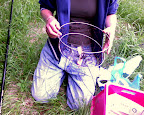
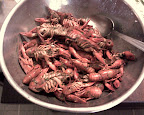
We went crayfishing the other day. Armed with traps that reminded me more of hanging fruit baskets for the kitchen, we’d strategically (read: right side up, in the water) set them down in the muddy stream, wait a few minutes, and then pull them back onto land. The  traps being little more than glorified nets, it was key to get it out of the water and onto land before the big bugs would crawl through the net and back to safety. We baited with some old sardines Claudette had in the freezer along with special crayfish (écrevisse) snacks (read: not-so-slim dry blood sausage slim jims). The little buggers preferred what probably more natural to them: the sardines (or maybe it had something to do with the snackies not being organic).
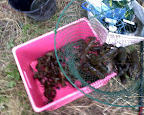
We were worried at first that it’d go the way of my flopped turkey  hunt last fall (no turkeys in sight, thanks), but after a few empty nets we caught onto their game, and ended up with something like 80 of the American guys (turns out they’re not native: they’re a pest that somehow got transplanted at some point—the better, I’m told, native crustaceans of bigger rivers are only allowed to be hunted one day each year). Cleaning them meant carefully grabbing the body with one hand (careful not to lose a finger in their pinching claws), and pulling out their middle tail-fin, vein (and digestive waste) included. Cooking them was deliciously straightforward: a hard sear, ample garlic and parsley, and a flambé of Vincent’s prune (plum) eau de vie (literally: water of life, really: fire water). They yield even less than Maryland blue crabs, so you need to be prepared with a patient appetite and to make use of the guts, not just the tails. There were lots of mosquitoes and thorns about, but a hyper- (as they say around here) fun time.
Friday, May 18

on flying

Lucid dreaming has been a recurring topic for me in years past. For those in need of a definition, imagine suddenly snapping to and realizing you are in the middle of a dream—not waking up, just becoming cognizant of the dream state. Worlds of possibilities arise. Safely rehearse pickup lines on imaginary bar goers, fearless of real rejection. The Porsche you’ve been coveting is in your garage, and it’s time for its afternoon drive. With the mere thought, pick up and fly, superman-style. There are websites dedicated to helping people dream lucidly. In years past, I’ve tried to go down that road. First step is to train yourself to wake up post dream state and take notes. I got that far, but have not yet followed through—google the topic to learn more for yourself.

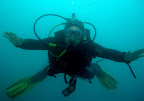
See, a lot of what attracted me to dreaming lucidly was the notion of being able to fly, fearlessly, naked if that’s on my agenda. The website teaches a few techniques, among them flapping your arms like a chicken or taking a deep breath and simply lifting off the ground. Irrespective of dreaming, I’ve been flying recently. Well, sort of. Done properly (which the past week of awesome classes andflying practice has allowed me), scuba diving is flying, underwater. And so  here I am, in this underwater world, floating higher on inhalation (not that kind of high, and not that kind of inhalation, though the nitrogen in your air will get you high if you dive deep enough), descending a bit on empty lungs. I still hope to start flying in my dreams.

Saturday, April 28

a bum in munich

Most of my time in Munich was spent wandering around, opting again to live the local unemployed life rather than the usual guidebook recommendations. Outfitted with Andy’s bike (too big even for him, a few inches taller than me), I made use of the city’s myriad bicycle lanes. I must have been a sight, peddling furiously and coasting in thirty-second intervals, unable to peddle while seated. In fact, coming to a stop meant either finding a lamppost to lean on or hopping off the seat while maneuvering the bike to an angle so that I didn’t damage that fun area where my legs come together. Still, it beat walking.

The English Garden (a park bigger than New York’s Central Park) was great: full of sunbathers even on a weekday afternoon, dotted with biergartens where, besides a pint of hefeweizen, the smallest pour you could get is a liter (the 17 year-olds at an adjacent table were outdrinking me with theirs). There’s even a section of river running cowabungawhere with an artificial wave for surfing practice. Then there are all of the community gardens throughout Germany—I love them. Not only are they much larger than the dinky plots I’m familiar with on the east coast of the US, but most are accessorized with glorified shacks, a grill, and beers kept cold in a fridge. In case you opt out of the fridge option, there’s usually a biergarten within a few hundred meters. My favorite more-or-less natural beauty site, though, was that of the Nymphenburg castle (more of a palace, really). The surrounding hundreds of acres of gardens were nothing short of enchanting. I was only able to peer through the locked fence of the botanical garden; actually visiting it may have made me cry. As if mocking our highly urbanized way of life in the big cities back a secluded patch by the castlehome, there were a few apartments just beside the botanical garden—of course they had their personal ‘secret’ garden plots hidden behind a wooden fence. I strolled about the area, cursing to myself in awe, asking out loud whom I’d have to kill to live out here.

Beer and food were obvious priorities—Andy and I went through lots of pints at his place (I didn’t take notes, but it was hard to go wrong with anything). I made it a point to cook at least a couple of times. Germans love white asparagus (spargel), and it’s reflected in their spring markets. One night we just grilled (salad on the side, thank you), and another night I went a little further, with four different salads, a roasted organic chicken (€10/kg!?!), and fresh hollandaise to accompany a pile of white asparagus I prepared. All in Yanni and GermanAndi’s beautiful house, in a great kitchen, on the patio of their fragrant garden.

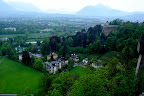
I managed to squeeze in a daytrip to Salzburg, where I finally let loose the tourist in me—visiting museums, riding funiculars, and even snapping a picture of baby Mozart in a cradle in his mummified view from up on highhouse (it was too cheesy to skip). The views from the old fortress were amazing. Here, on a fortune based on salt (a basis, in turn, for the town’s name), an empire would withstand Roman conquest in large part due to its strategic perch on a steep hill overlooking town. I even managed to enjoy a great meal at an otherwise touristy-looking restaurant by the funicular. On my way back to the station, I bought a beer to drink on the train ride back to Munich (more for the novelty of it than anything else), but was really just too stuffed from lunch—so much for novelties.

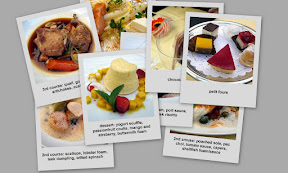
My last act in Munich was to be a fancy meal out. I asked my newly acquired German friends, and after much deliberation, the conclusion was that I should head for Tantris. So I peddled coasted peddled coasted my way to the restaurant, anticipating my first truly fancy meal since I was in Morocco (at ten times the price, of course). I don’t even have to admit (those who know me probably know this regardless) that I was very afraid of a letdown. I ate a brilliant seven course lunch, forcing myself to think in dollars rather than euros so as not to jolt the food back out of my belly. I subsequently beached myself on a grassy patch amongst the hordes at the English Garden. There I pondered the meaning of life before heading home to pack and mentally prepare for the transition to speaking yet another (not so) foreign language.

Monday, April 23

München

I hit the ground running in Munich. First things first, Andy and I split a couple of sausages upon my arrival at the train station. With my eight hour meat-fast finally over, we went on to bigger and better things, tasting through several of Germany’s finest brews back at Andy’s flat. Not to underdo the evening, we met up later with a few of Andy’s friends and colleagues at a smoky, crowded bar, complete with attitude-ridden servers. EnglishAndy showed up just in time for the second round and, living up to my English stereotypes, made it his mission to keep each of our pints optimistically half-full. It wouldn’t have been so bad had we called it a night at a reasonable hour, but of course we crawled from pub to pub, prioritizing morning headaches over good night’s sleeps.

We had a huge day ahead of us, so it wasn’t a huge surprise that we overslept, waking only as GermanAndi was waiting at our door. It was the classic late-for-school moment, and we played the parts, fumbling in our respective hazes, packing painkillers for the excursion. We piled into Andi’s beautifully-restored 1971 Alfa Romeo coupe, and met with his girlfriend for a typical Bavarian breakfast, complete with spongy floating sausages and pretzels. Breakfast was good. The rest, however, was a picturesque dream of a day.

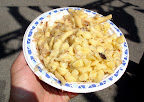
We took the Alfa to an old-timers’ rally and spent some time gawking at the remarkable rides—some weird, some cute, and some downright sexy. Andy and I ventured into the fairgrounds, taking a look at a rather typical Bavarian carnival—rides that make you puke, food that makes you balloon. We stepped into a mini-me version of the huge beer tents that line the grounds for Oktoberfest. Fish on a stick (not that processed thing we call a fish stick back home—a real trout grilled on a stick), ham hocks, and crispy pork roulades—the foodstuffs of Atkins dieters. And of course their antitheses: liter-sized mugs of beer. Still full from breakfast, I still had to try some of the local spaetzle-and-cheese (beats the Kraft version), and another version prepared with ham and kraut (needed a little more ‘stuff’ mixed in).

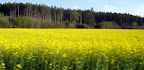
After finding Andi, we were on the road, doing a grand tour of Munich’s surroundings. He showed us some of his favorite (for their fun-to-drive windy country road feel) shortcuts that he’s been known to push to the limit (his dad works for BMW and he has a friend who tests their prototypes). Part of me is disappointed I didn’t take notes as to the names of the places we visited, but the rest of me does/didn’t feel it necessary in the least. Regardless, we motored by just-blooming trees and fields aglow with yellow rapeseed flowers (their harvested oil is used as a sustainable energy source). Everything about the day was wonderful, down to the perfect weather.

It was great to see some of the things you just don’t see anywhere else. On the lakeshore, by a grassy patch brimming with sunbathers, we visited a biergarten alive with clientele who obviously know how to relish a beautiful Sunday afternoon. Not to be taken as a culture of beer-drinking idiots, there are lots of popular alternatives to straight beer—you can drink a thirst-quenching mix of sparkling water and apple juice (any juice, really), or, if you still want a lighter bit of EtOH, that can be had as a sweet mix of hefeweizen (an unfiltered wheat beer) and lemonade.

As it was Sunday, Andi and Andy thought it would be nice to visit a beautiful old Monastery with a beautiful baroquely (my spell-checker says that’s a word) decked-out church. The main draw of this hilltop Monastery, at least on this afternoon, is its (drum roll) biergarten. We sampled the beers and gorged ourselves on cured meat and cheese products (stemming from another cultural tradition here that’s best translated as bread time). The monks also make schnapps, of which we sampled four, in the form of nips that Andy (Andi was driving) and I took turns emptying. Full and buzzing, we finally headed home.

Sunday, April 1

crabs

view of the sea in tangiers Let's gloss over the touristy crust (the casbah in Tangiers is gorgeous, especially its views of the sea) and cut to the juice--let's face it, you can read about most of this stuff elsewhere. Lonely Planet, however, still won't talk about my fantastical tales of nefarious taxi drivers and dark alleys, so you’ll have to read them here.

Nacer was to spend the first part of the day with us, then report to work at five sharp. He was already yesterday evening, so we didn’t want to put him out again. As a kind, loving, most generous local, he was not familiar with our style of traveling: always the adventure, never knowing what’s around the next corner.

Being the helpless white people that we look like, Nacer helped us find a grand taxi to Asilah (a town known for the artwork on the walls within the medina) after our huge lunch—no big deal, there’s a veritable parking lot full of million-mile Mercedes’, right? Seems that this time of year people want to go to Asilah, but they don’t want to come back to Tangiers, so the taxis just don’t drive to Asilah. We sat around and waited. And waited. Nacer kept us company. We finally gave in and called over one of Nacer’s many friends, Mohammed, and hired him to drive us. We took the scenic coastal route, and would you believe it? Yes, Nacer remained with us for the journey. We drove past jaw-dropping estates of rich emissaries, bankers, and drug dealers. We peered at the Atlanticgrotte d'hercules  through the eye of Hercules’ caves. We drove past an area dotted with flashing red lights atop tall towers. Nacer explained it was once a French base, but is now an American base for “espionage.” I asked him what exactly he meant—I mean, if they’re spying, should it be public? He shrugged his shoulders, said he didn’t know what they do there. I guess not.

5:30pm, and we were in Asilah. Nacer shrugged off his tardiness: it was, after all, only 4pm Moroccan standard time… He (or rather, a guy he bumped into on the street) helped us look for an apartment (it’s all the rage these days to restore flats in the picturesque medina and rent them out to rich foreigners) for the night. After looking at three, I was content, and paid our “guide” for his mural in asilah services. Not so fast. Mohammed had called from the car: he ran into a friend, Zuber, and Zuber offered to put us up for free in a friend’s flat. Wow. I really didn’t know what to say to this complete stranger. Moreover, he was in charge of the fish consortium, and having noticed me eyeing the sizeable live crabs at a fishmonger’s stand, offered to arrange dinner.

Alas, the flat was not complete in its renovations. Myself, I could have stayed the night, but we wanted a real toilet seat (western toilet, but no seat) and hot water (not hooked up yet). I was mortified with the prospect of refusing Zuber’s most generous offer, but they all took it in great stride, with an air of understanding. Half an hour later we had moved into the first flat I liked. Even though it was nearly 8pm and his prospects for working that night were shot, Nacer wouldn’t agree to stay the night with us; he had class early the next morning. Goodbyes went around, complete with hugs and kisses.

Zuber would drive us to dinner, but not before some shopping. Mom spotted a couple of beautiful silver Chamsot (the Hebrew word for Hand of Fatima), they were solid silver and accordingly pricey for small gifts. Shiri upgraded to a new pair of shoes. Zuber went off to get the car, and minutes later, my phone rang. It was Nacer. The cryptic conversation went something like this: “Jonie, I forgot to tell you, don’t say you’re Jewish. I didn’t mention it, but it’s just not something to bring up in Asilah. Zuber called Mohammed and he asked about your religion after he saw what you were shopping for. Don’t worry about it, he was just being curious, it’s nothing to worry about. If he asks, tell him what I told him, that you’re just Americans.”

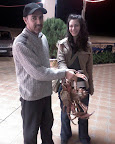
Needless to say, the drive to the restaurant was a bit awkward and definitely longer than we had expected. The redeeming moment was when Zuber unloaded our two crabs from the back of the van. We’d nacer and shiri with our crabs be eating well. Inside, we chose a couple of fish to supplement the crustaceans, and promptly got to work. Zuber force-fed us half of the lamb he ordered (he stays away from seafood whenever possible). The crabs were great, and we enjoyed the amazingly fresh fish in spite of their being overcooked. I can’t say I was surprised when he refused payment for the crabs, a preposterous gesture.

Tonight was Shiri and Ziva’s last night in Morocco, their return flights began in Casablanca, and it was time to settle on their transportation to the airport, 4-6 hours away. No sweat: take the train or find a grand taxi as a last resort. Mo helped me out, texting me the train schedules. Never simple when you’re short on time, there was a Mushkill: the only possible train was at 6:40am. The train was vetoed in favor of savoring a bit of the morning. I asked Zuber where to go the following morning to find a grand taxi. “Why didn’t you ask sooner!? We have to take care of it right away—they need to get permission from the police to go to Casablanca.” Oops. We drove around, to the pier to find his friend, back to his house to get a phone number, then to ‘a guy’s’ house. It was late. Too late—‘the guy’ was asleep and dead to the world. So we resorted to the grand taxi stand itself, and found a driver willing to make the trip—direct, no stops (I smiled and nodded, knowing I could more easily spring the stops on him during the trip). Signed, sealed, delivered. I felt terrible—Zuber was obviously exhausted. Despite being a complete stranger and weird about Jews, he had gone above and beyond for us.

Back at the flat, we finally got the chance to shower. I stepped out to get more minutes on my phone, and finding all the nearby shops closed, was at a loss. No worries, a big guy with a club in his hand was coming my way, and he looked like he might be able to help. No, really, I’m serious. He dawned a reflective fluorescent orange vest—uniform for the guardians charged with keeping the medina crime-free. Mohammed, as he was called, walked me out of the medina to a booth selling recharges, and all the way back to my place, meanwhile trying to make polite banter in FrAraSpish. This country never ceases to amaze.

Saturday, March 31

train ride from hell

Morning in Asilah was beautiful. We arranged the taxi the night before, so we woke up early to take advantage of the town's sights--snapping pictures of the famous murals and doting on all the cats Morocco is famous for (in my mind, anyway). We bought a few paintings we had been eyeing the previous night—fumbling, rushing to get the canvases off their frames, worrying about damaging the rather-dry paint. Our taxi driver hunted us down, an easy feat in this tiny medina, silent as it is early in the morning. We finally rolled up the paintings and skedaddled. Lots of tranquillos (they speak more Spanish than French in these parts) were thrown about, urging me to take my time, to chill out—maybe if I’d had a puff of what he was on…

The driver was of course a bit dérangé (I love this French word for angry; deranged is so much more colorful than angry) when I told him of my plans to get off in Rabat. He argued I should pay him extra, that it was out of the way (it’s right on the way), I argued tranquillo—there are always bigger fish to fry.

After stopping at the police station to get the proper authorization to drive us to Casa, we were on our way, doing a cool 80kph (50mph) the whole way—annoying when you base your math on faster, saner speeds. Still, we had budgeted plenty of time, so tranquillos we remained. At least until I motioned to my next detour—I had originally planned a short stop at some “exotic” gardens along the way, but we were clearly short of time for that now; instead, I was just hoping for something more scenic than the main route. The driver pretty much freaked out, worrying the police would nab him for deviating from his route, whining about extra time spent on country roads and driving through towns. My mom joined him, questioning whether they’d make their flight. I could not blame him, but still, tranquillo he was once we got back onto a speedier road.

Like in Europe, every region of Morocco has its particular indigenous foods you can buy from peasant peddlers on the roadside: I’ve seen peas, favas, cheese, honey, and argan oil. Today was something new: balls of dirt. I was intrigued when our driver raved about them, but he could not come up with any words outside of his native Arabic: turfa. We stopped and talked to one of the peddlers, rinsing off a dirt ball to reveal an irregular cream-colored core. He took a bite out of it, proclaimed it worthy. I finally understood the gesture he kept making—he was miming eggs, as in cracking them into a bowl. Everything clicked for me: we had stumbled upon indigenous Moroccan truffles. I never think to associate Arabic with romance languages, but sometimes a truffe becomes a turfa. They were mild and bland, but ripe enough. Besides, the novelty killed me: I bought a kilo for $5.

Too many tranquillos later, I was dropped off at a train station near Rabat, to have just missed a train. They were sold out of first class (reserved seats) tickets for the next train, so I slummed it and bought a second-class ticket I would never need. I sat around waiting for the next train, which ran an hour late, and was packed chock-full thanks to the holiday weekend (the Prophet Mohammed’s birth). So packed, in fact, I couldn’t even get onto the train. I sprinted the 200 yards to the opposite end of the train, seeing less people crowded around the doors. Panicking as the conductor started to give the all-set signal, I seized upon a favorite adage: there is always room for one more. And there was, except for that I was holding on for dear life until two stations and 45 minutes later, when I finally got inside the door…
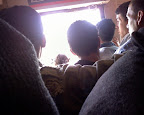
I had already earned the respect of the guys whose rear ends I had become familiar with—we were fast friends. I made it home five sweaty hours later, looking forward to a poker game. The train ride had my cards in a funk, though: I lost all 100 dirhams ($12). I’d later hear from the family that the driver was even more obnoxiously tranquilloing them after I left and, in a final gesture of helpfulness, squeezed the roll of paintings hard enough to cause damage. Tranquillo, he insisted to Shiri.
Thursday, March 29

on the road with Shiri and Ziva

It was a full house come Tuesday night with EB, her mom, and her sister. The plan was for Shiri, Ziva, and I to leave for Chefchaouen early in the morning. We figured we’d take a bus—we didn’t want to deal with arranging a grand taxi, and no trains run that way. We didn’t count on stomach problems—all of us were upset in one form or another (we blame breakfast or lunch from our previous day). A new low was reached when Shiri vomited. We waited until everybody felt safe for the five-hour trip and then headed up the wet, steep hill out of the medina, carrying my one small travel umbrella and three big duffel bags.

I was soaked by the end of the ten minute walk and went off in search of a suitable taxi (the direct buses for the day had already departed) after depositing Shiri and Ziva at a café. My trusty umbrella preventing my dripping hair from getting any wetter was of little consolation—the taxis were much further than I had been led to believe. Smelling the tourist in me, the prices were inflated, and besides, there wasn’t anybody really out braving the weather, so drivers were reluctant to make the trip. In a last act of desperation, I went next door to the el-cheapo bus station (the one with the fancy buses is across town) and found an option departing in fifteen minutes. I ran (as will this sentence J) to a petit taxi, made him wait while I again ran to find my folks, pay their tab, and recharge my phone card, then got back in, rushed back to the station to purchase the tickets and get on the bus [DEEP BREATH, drip, drip].

The bus ride was fine for the most part. We had another hospitality moment as I offered some candies with the bearded man across the aisle and he reciprocated with handfuls of pistachios. We stopped in Ouezzane to change buses, drink some tea, and use the toilet. The ticket man for the connecting bus tried to overcharge me for the luggage—what did we look like, tourists? I knew better and paid him no more than his due, but these constant episodes eventually drive a person to remain home all day. Ziva was put off by the squat toilets and opted to wait, though when she was led to a different facility (they must not have grasped the issue at hand) she swallowed her concerns and performed, only to be chased back to the café by the toilet guardian who wanted—drum roll, please—payment. It got pretty windy and stomach-turning toward the destination; Shiri had me prepare a barf bag as a failsafe.

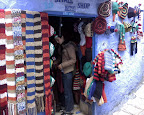
We finally got dropped off at the edge of Chaouen’s medina as the sky grew dark, and in contrast to my first visit to the town, a group of otherwise-adorable children immediately accosted us and insisted to help with our luggage. This time, though, we were prepared with candies and souvenirs. I paid them off while we had our fireplace lit up at the charming hotel. As it was already getting late, we had time for little else than dinner and a quick walk through the beautiful blue town. Not before meeting Hat Man, however—his shop a Rasta Hat Man's lair caricature, replete with the cloud of aromatic blue smoke. His knitwear was fascinating and priced so fairly I had trouble carrying out the ritualistic bargaining. Back at the hotel’s family room we found a group of men getting high and playing music. We opted to sit in, though we abstained from participating in anything but drinking tea. The hotel’s owner was an interesting Italian chap whose vibe is best summed up as a little weird. Lots of young male help, all getting high; the picture was simply disconcerting.
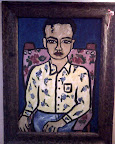
The last embers from our fire kept us warm as we slept. My alarm clock failed, causing a late awaking, and we scrambled to make the best of our short morning. Breakfast and packing was followed by some nearby gift shopping and a hasty second trip to chat with and buy more knitwear from Hat Man as we waited for our hotel-arranged grand taxi to Tangiers. It was a disappointment, then, when the taxour Italian hotelier's self-portraiti driver finally arrived but wanted double what the hotelier’s “son” had  quoted me. It was all a very shady ordeal—the hotelier got defensive rather than apologetic, insisting on the higher price. I would have been negotiating for a taxi or searching for a bus hours earlier had I not been misled to wait for the crooked taxi. Alas, on our walk over to the taxi stand, the shady driver offered a discount, and desperate (now a theme), I accepted.
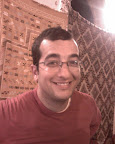
Nacer Nacer met us as we arrived at Tangiers and helped us lug our luggage up to his fifth (European=American sixth) floor walkup before a quick tour through town. The traffic in Tangiers was about as time-consuming as the drive from Chaouen. He handed us off to his friend Marouane who generously accompanied us and kept us out of trouble until we left for dinner at Nacer’s hotel. The thing is, apropos this approaching hospitality moment, is that I would rather have eaten elsewhere. I knew this even before I saw the menu (actually, it was a buffet). I agreed to the meal for the same reason I agreed to stay in Nacer’s apartment—for the magic Moroccan idea of hospitality. For the same reason they all need to give, I have almost come to feel it my duty to accept. It was not good enough for Nacer to give us a few recommendations or to hang out for a while—he needed to host us and make us feel a sense of welcome that is alien back home. So I was only slightly surprised when the manager informed me that our meal had been completely paid for by Nacer.
In a final flourish for the night, Nacer arranged for a friend to drive us home. My mom was understandably frustrated not to be able to just pay for a night at Nacer’s swanky hotel, which is what I would have insisted upon were we to do it over again. Still, as history has it, we climbed up to the apartment and bared it. Sadly, but hardly surprising us, we were without showers or western toilets. This, of course, only added fuel to my mom’s fire, and it was all we could do to go to sleep without further conflict.

Tuesday, March 27

my two Youssefs

It is difficult to completely convey what it is like to travel here. I say “convey,” not “describe.” I don’t believe I exaggerate by claiming to be able to give a good description of life out here, though I readily admit the chip on my shoulder. That said, as for conveying, it’s just hard to wrap your head around days like these until you experience them. I therefore accept that this blog will never convey everything, and you’ll have to spend at least a couple of weeks out here to feel it out for yourselves. It will be scary and stressful, but this is just all too amazing not to see for yourself. I took up Youssefb on his offer, probably more as an excuse to chronicle the escapades than any other reason. And so the adventure goes on:

My family’s time in Fes being limited, I first took them to the famous tanneries in the morning. Shower time was amazingly time-consuming as always and, despite the best of intentions, we weren’t ready to leave until 9. It remains a mystery why I decided to wait for the maid for another hour. Finally fed up with waiting, I texted EB to let her know that the maid had not arrived on time. Perhaps this was a sure sign she was indeed our thief… So we made like fetuses and headed out for our rainy adventures. Lesson learned (duh): one umbrella, regardless of size, is never large enough for three to share. A pocket umbrella, however, is hardly enough for one.

The tannery continues as it has since the tourists arrived sometime during the latter half of the 20th century: the experience begins with a relentless onslaught of locals smelling credit cards (a feat considering the stench in the air): “welcome, come in, you don’t need to buy anything.” They’ve pulled you into their shop before you can react, with a sprig of mint to shield the nostrils and promises of great views; a harmless man offers an explanation of the goings-on down below (and of course becomes your shadow for the duration of the visit). You look, sample their overpriced (tourists shop here, not locals) wares before pushing aside your shadow who is now asking you for a tip.

I headed us toward where I imagined the closest taxis would be, as we had to meet up with Youssefa, the driver from the crazy midnight Casablanca journey. I instead walked us the long way to the pickup spot through a miscalculation of our position. Still, we were right on time, though Youssefb was getting ansi and had called twice already. In all honesty, so was I: it was 11, we hadn’t yet hit the road, and we were still hoping to visit several towns an hour out of Fes.

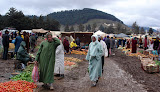
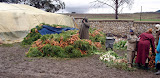
Suffice to say that, as far as tourism was concerned, the day was a bust. The souk (market) at Azrou, our first and farthest stop, was Azrou Soukrendered one giant mud pit—I was glad my sister imported my boots. It was great to see and experience nonetheless—amazing produce  and hundreds of shoppers out braving the sleety rainy mess. Next stop: the cedar park where there was snow on the ground and the apes, smarter thaAzrou Soukn I am, were safely tucked away in their homes, up in the trees?  Youssefa, Youssefb, and I watered the trees before moving on, obligatorily backtracking through Ifrane for a much needed pot of tea before taking the turn toward Sefrou, Youssefb’s birthplace. Youssefa was tired of getting out of the car by this point; we should have taken the hint.

The rest of the afternoon seems like a whirlwind. We stopped in a town by Sefrou for a good ninety minutes, being offered food and awkwardly drinking tea at an old friend’s dilapidated house. We Shiri and Me browsed his third-hand shop next door, and then my prayers were answered when Youssefb agreed that we were too short on time for a meal. So we booked it to the waterfall for a quick peek. We next ran to the cemetery along with his old friend,Youssef(a), Me, Shiri, Ziva, Youssef(b) where we snapped a group photo and escorted Youssefb as he lit candles in remembrance of his mother (dead at the age of 38) and other, more distant relatives. Then it was off to the medina, where we spent twenty minutes waiting for Youssefb to drop off some gifts to a friend before being taken to another friend’s scary-weird (there were stuffed animals—taxidermy-style—staring at us from every-which direction) spice shop and offered awful souvenirs. All the while I’m whining to Youssefb about our fast-approaching dinner at Mo’s, telling him that we must leave immediately for Fes. He doesn’t get it, keeps insisting that Moroccan’s always run an hour late (I’m not Moroccan). We stop to see another now-defunct synagogue/charity center.

Bless his heart, really. Here we are getting more annoyed by the minute (my mom could hardly stand him anymore, with his endless errands and friends detracting from our tourism), and he continues to try and be a good tour guide. I reminded my mom (and myself) that these outings are more about the crazy adventures of sweet old men Group picture--dinner at Mo'sthan the sights in Lonely Planet. Youssefb kept insisting we accompany him back to his apartment for tea/snacks, but I held fast to mission: get out of the taxi. All’s well that ends well: we made it to Fes perfectly on Moroccan time and had an amazing dinner at Mo’s, a fun reunion of my mom and sister with EB’s.

Sunday, March 25

a bad omen revisited

[This blog was written at 4am on the way back to Fes from the Casablanca airport run]

We stopped for the traditional roadside fare: grilled meat. We tried to order a goat's head, but they were all out of them by 12:30am when we finally arrived to eat. Seeing plenty of ovine carcasses with male anatomy attached, we also tried for an order of testicles, never having tried the delicacy, but were again out of luck. So we settled for kefta (well-seasoned ground meat and fat).

The trip is longer than I expected. At 330 we were still a good 45 minutes out of Fes. In retrospect, a hotel for the night in Casa would have made as much sense as the taxi--I had imagined we would arrive in Fes closer to 2am. To compound the problem, tonight marks the beginning of daylight savings, so really it’s now 5 in the morning (my morning sobriety corrected this fallacy--Morocco does not observe daylight savings).

News Flash: About twenty minutes ago, on the final stretch home, the Benz made an incredibly angry noise. It growled, really. No, it was more of a roar. Suffice it to say that I have never heard a sound like it, not whilst riding in a car. The driver took the taxi out of gear and we coasted along in a very rough neutral for a several minutes, taking advantage of a gradual descent. It wasn't a flat tire, though the engine's screaming gyrations almost made it feel like one. The hill leveled out, and he shifted back into second to get whatever mileage he could. We made it all of two hundred meters before the car ground (actually ground) to a halt.

If I had to guess (I did), I’d say it sounded like the oil pan just dropped was ripped off of the taxi. The initial jolt was brought me back to full consciousness after dozing for a few minutes. The driver (Youssef) and I grunted and performed the manly ritual of lifting the hood and nosing around. It wasn’t the radiator, as one might have guessed given earlier signs. We took a look at the oil reservoir, and it was smoky. The driver began making the requisite phone calls when I went back out to investigate the trickling sound I heard. Youssef was just beside the vehicle, ruling out the bodily function the sound most emulated. The fluid streaming from the engine was black as the sky above--indeed, this was a serious mushkill.

Lesson learned: Listen to the car before hiring it for an eight hour tour. It's not all about the cheapest rate.

Fifteen minutes later we were hoisted onto a flatbed truck, to be hauled back to Fes. I’ve never had the privilege of riding in a car being towed. It was oddly unsettling in the darkness, though I reckon it would be fun during the day. A few minutes later and we rendezvoused with Yousef’s son, who brought an alternate taxi for the last few kilometers home.

Sometimes these blog entries just write themselves...

You all remember your lines, yeah? Everybody now, please; let's say it together: Fes. Saturday night. What’s gonna happen next?!?

figuring it out

[This blog was written in a “grand taxi” (big old diesel Mercedes Benz) on the way to Casablanca from Fez to pick up my mom and sister, Ziva and Shiri]

A sad state of affairs: I loaded my blog today to show Mo. Looking for snappy photos, I quickly scrolled through the ten posts available on the page, as he still doesn't participate very much in English. I was dismayed, and feel remiss about the state of affairs I found, though it is thanks to a natural evolution. I do have some photos that I'll shortly upload to accompany some older posts, so poke around in the coming days. Further, my impromptu visitors (they just decided last week to fly over and visit during Shiri’s spring break) bring me an old digital camera to supplant my cell phone as primary photo-taker. In short (long, at this point), I will try to be better about posting photos. That said, I wish I could get you all to interact more; a week after explicitly asking for feedback, I just received my first comment on the matter... Alas.

Evolving: I began this blog as a see-what-I’m-doing project for my friends back home, and it has progressed and changed over the months. I’ve begun to feel at home here, and the photos have diminished as a result. I now know shortcuts and I have favorite butchers. I buy milk from just one guy, and get my butter from another. I have set out to do most of what I came here to do: know a different way of life. Mo and I are practically brothers—I spend perhaps more time with him than EB does. I’m having a great time, but it’s different than the adventures of the start, and I write more about the day to day than the road trips.

[I interrupt my story to bring you a special news alert: my taxi driver, while stopped to top off the gas tank with a couple gallons of diesel, opened his hood to feed the steaming radiator some fresh water...Not a promising sign for a seven-hour round trip.]

Most recently I reached a new extreme (call it a high or a low, your choice) with my freak-out, and tonight I’m hoping to share some of the afterthoughts. I’ll be honest, though: I’m cheating. A few nights ago, while writing to an old friend from my first days as a cook, I vomited some ideas into my word processor. In retrospect, despite the obvious crudeness I was surprised to find the overall message coherent. I’ve preserved its raw nature below, cutting here and there to keep personal matters personal:

...I'm thinking I'm probably going to leave here in a few weeks. Probably second week of april. Don't have a plan for april, probably make my way through spain/france as cheaply as possible, or just find a flight straight up to NE france/Switzerland/germany area--there's you in Munich, Zoe in Geneva, and a family--friends of mine--in Lille. Maybe do some combo of the three, as they're all places I'd like to check out (and people I’d like to see). Maybe figure out what this whole hitchhiking thing is all about and see if I could do that through france...? I dunno...playing this all by ear. Probably try to find a cheap flight out of Germany to Israel where I'd visit for a couple/few weeks... then if I need to go to the US to take care of my apt in nyc, I'd do that, maybe try to rent out my place in Chicago, before returning to france area to work on a farm for a couple months... wow. That's about the most coherent I've been about this whole journey of mine--I might need to copy and paste most of this email to explain to others...:) Can't wait to check out your part of the world--hope you have some good brasseries and sausageries for us, though not the kind of sausagerie I had here at my place for st patty's day--a room full of 12 guys, and not even a single female. I mean, okay, romantic aspect totally aside, which at this point it is, it's just nice to have that break in the testosterone, you know? Hell--this could even be a fun stream of consciousness blog post--whaddya think?

Be in touch,

--j