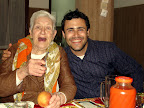
Showing posts with label hospitality moment. Show all posts

Thursday, December 17

aikido

When I was younger (much younger), I remember getting signed up for some summer classes at the Northridge Park community center. We’re talking twenty-plus years ago. I remember seeing other kids my age, shouting something (counting?) in unison, doing jumping jacks on tatami mats. They wore white robes. They were learning how to beat up other kids; kids like me, who were instead signed up for piano lessons with the overbearing old man. I reckon that overbearing old man was part of why I would eventually rebel against the ivory, giving up a bright future on my Yamaha keyboard.

Fair enough, I never got beat up, but it would have been so cool to earn a black belt. Whatever: I eventually blocked out the painful memories and picked up the alto saxophone, earning me the respect of all the babes in high school. Hell, I practically dated Winnie Cooper (sorry: perhaps an arcane reference)! I’m all growns up now and in Belgrade, and all but forgot about this episode of my life (well, the piano teacher/karate bit). And then Miloš told me about and invited me to the aikido classes he takes three times a week. As all the memories returned, a puddle of tears collected at my feet. I would earn my black belt, damnit, even if it is too late to regain my dignity. So I tagged along, ironically checking my dignity at the door.

Like most of my time in Belgrade, for every five minutes of instructions in Serbian I got an average 30 seconds’ translation. Still, as awkward as it was to try and join the routine, I got to rather enjoying the classes. I tried to pay for the class but (yes, you guessed it) my money was refused on the grounds of my visiting guest status. My favorite class was when we ran around the room (fast) for 20 minutes before proceeding to do all manner of squat-jumps, somersaults, and the like. I pushed my old out-of-shape body much too far and ended up barely limping home later that night—it was great to have such a thorough workout.

All went well until one class when my foot ended up under Miloš’s. No big deal. We switched sparring partners and then, long story short, my other foot’s big toe made an audible (to me, anyway) snap as his foot came down on it in an awkward way. It got pushed back and mildly fractured. I, expertly playing the part of wimp, buckled down in pain. I limped home that night and, between my toe and my increasingly-busy work schedule, never ended up making it back. Alas, my black belt would have to wait until my return to Boston…

Saturday, December 12

grilled tubes

“Tubes” are the best commonly understood translation of intestines between me and the cooks. When I need to stuff sausages, I must remember to ask for tubes, not casings or intestines. I have eaten my fair share of such things. Sausages: no problem. “Pig a**hole” in Chinatown: sure. Funky rolled-up lamb intestine stew at a nearby kafana: actually liked it. Tonight, though, I was stumped. Mirko and I, given that we will soon be parting ways, went out for dinner at the oldest restaurant in this part of the world. Named simply with a question mark “?,” it is known for its age and its traditional Serbian cuisine.

I pride myself for eating, or at least trying, anything and everything. So I was actually looking forward to the grilled “tubes” tonight (further down the digestive tract, these were not the thin things one stuffs with fresh sausage: these are thick-skinned, funky-smelling parts of the pig’s digestive tract. Upon first sniff, I knew it would be difficult. The first bite was even more succinct in its message: no way. I tried a second and a third time, with raw onion, with mustard, but to no avail: this was one dish I could not handle. The rest of the food was good: nice sauerkraut and piktija (pig head cheese, Serbian style), and decent “veal cooked under brick.” At the end of it all, while I dug through my pockets for cash, Mirko disappeared and settled the tab: it’s impossible to pay for anything in this country. Next time, perhaps (eating and paying, I suppose), for if at first you don’t succeed, try, try, try again…

Tuesday, November 24

lightning round, nagar style (1/2)

I have had no time for writing of any kind this past week. Work gave way to my family’s arrival ten days ago, and I was destined for the role of tour guide extraordinaire. They arrived without their luggage, a frequent occurrence in these parts, it turns out. Their airline, however, was kind enough to give them some spending cash to compensate. Cash in-hand, with them I was finally able to explore some of the Serbia I have been too busy to see. Here is part I of a brief recap, to the best of my memory.

We spent the first couple of days getting acquainted with Belgrade proper: a trip to Kalamegdan fortress (a simply beautiful place to stroll around), a walk down the pedestrian-zoned downtown Knez Mihailova street (shop til you drop—literally: you’ll faint at the high prices on anything produced outside of Serbia), a visit to the Jewish History Museum (enlightening) followed by a look inside the only operating synagogue in Belgrade. The weather was highly cooperative—mostly sunny, usually warm enough to eschew heavy coats. We visited some new (to me) restaurants. For the sake of documentation, Lovac, a game restaurant, was largely a disappointment. Šaran, however, an old fish restaurant in the old neighborhood of Zemun, was great. Zaplet (where I work) was the overall favorite, my mom especially enjoying traditional food that reminded her of what she ate as a child in Israel.

Unable, at the last minute, to join us on a trip to Mokra Gora, Vladimir instead arranged for us be driven in a friend’s car. An amazingly generous and ridiculous gesture, an extremely polite man by the name of Ivan drove. Since Shiri, Viktor, and I had gone out late the night before, I was in and out of consciousness for the spectacular drive. The landscape was stunningly beautiful and we drove by numerous small towns and through thousands of acres of farmland. The trip was largely an excuse to relax and be away from the bustling city. We arrived and started a fire in our cozy wood cabin. We napped, ate, and talked about various business and investment ideas (typical Nagar conversation). It was nice to sleep a bit and we all enjoyed exploring the surroundings, hiking down the hill to a nearby village in search of a fabled farmers’ market we had been told to visit, but could not find. So we began the lazy return to Belgrade.

We stopped in Užice to visit its farmers’ market. There, we found some great kajmak and fresh goat cheese from a man selling a variety of dairy and smoked meats. We also stocked up on apples and pears, buying some homemade wine from the same woman. Yes, homemade wine, at an open-air market. Homemade wine sold in a variety of old soft drink bottles. Did I mention I love this country and its lack of regulations? Where else can you buy this kind of stuff? Onward, we stopped at a floating restaurant on the bank of a river. Old men fished from the restaurant’s patio and from nearby boats. Sadly, though the fish was ostensibly fresh, grilled really meant deep-fried to an overcooked dark brown. Indicative of the relaxed Serbian mentality, the wine I had ordered upon first sitting arrived toward the end of our hands-on fish eating contest. Since we were going to have the main course on down the road, we sent it back and got the check instead. The next place was a nondescript house marked with nothing but its address. Ivan heard about it from a friend who lived nearby, and it served only traditional Serbian style veal breast, slowly roasted. An excellent main course, though quite too much food, as usual. Judging by the shape of the car when we returned, Ivan managed to remain awake for the rest of the drive back; none of us were so successful.

Stay tuned for the second part of this exciting tale!

Tuesday, November 10

butchering buša

Though I have experience butchering small livestock, before last week I had never really done any in-depth butchery with beef or veal. Last month, knowing that we would have the opportunity to work with less common animals such as Mangalitsa pigs and Buša cows, I sought out advice on the best uses for their various parts. Mangalitsa pigs turned out to be well-documented thanks in large part to Heath’s efforts at Wooly Pigs’ in Washington state. Buša cows are another story entirely—searching several permutations of the name turned up next to nothing, besides some very basic technical information about the breed. At one point, though, I found an email address for a man named Zoran, listed as the Buša breeding contact in Serbia. I wasted no time getting in touch with him, and he was quick to respond to my inquiries. Not only did he give me further information about the Buša cows, but it turns out he raises Mangalitsa pigs as well.

It seems that Buša were traditionally raised by subsistence farmers in the mountains where the milk, rather than the meat, was the primary product. As such, the cows would typically be slaughtered at an age approaching 15 years—resulting in meat more suitable to braises and stews than anything else. In any case, Zoran promised to be in touch when the time approached to slaughter one of his animals.

Last week, as promised, he wrote me of a Friday slaughter of his Buša bull, 1.5 years old. I quickly replied, and we agreed that Vlad and I would drive out to their town of Vršac to see whatever we could. As the slaughter was early in the morning, we skipped it and instead drove straight to his house, where we were invited in to meet his beautiful family as well as his butcher of 50 years’ experience. This was indeed a family affair, attended by his wife and two engaging children, as well as his mother and father. The butcher, in a fashion I’ve never before experienced, had meat spread out across the wooden dining table, using a small cutting board to do the work.

I cannot say enough good things about the experience. It just struck me as the right way to approach the meat we eat. Here were two young kids, playing with the bones, watching the butcher at work, and helping to take the meat upstairs (where it would be laid out on the floor to rest overnight before being frozen or further processed/cooked the next day). Zoran gave us tastes of his friend’s acacia honey, his father’s two year old bacon, the last of the season local grapes, some grassy fresh goat cheese, and his own unfiltered apple cider. Zoran’s wife, a physician, told us of the healthy nature of the Buša’s omega-rich fats, pointing out bone marrow (love it) and fatty cuts, mentioning the liver as especially beneficial to the kids, with its concentration of iron and vitamins. The event seemed straight out of Barbara Kingsolver’s Animal, Vegetable, Miracle (I recently finished reading it).

While we came for ideas in using the veal we had at Zaplet, we left instead with a warm fuzzy optimistic feeling about family and life. And death: the butcher went on to show us how he kills the animals, with a purposefully-designed gun made by none other than F. Dick, better known for their utilitarian knives. We had to run back to Belgrade before the family had a chance to put me to use in the kitchen, but they have an open invitation at Zaplet. I look forward to our next encounter, and hope that I can provide as well for my future kids.

Wednesday, October 21

animal of the party

Those who actually look forward to reading my stories may have noticed a gap of several days last weekend. No, I did not embark upon an adventurous road trip. Nor was I kidnapped and held hostage by the local drug cartel. Less, exciting, I know: I was getting indoctrinated into the local entertainment scene—what else would one expect of a foreign tv commercial star? Yes, two weeks later and I’ve only just begun to party… As a result my bedtime shifted several hours later, and my alarm clock never knew so many snoozes were allowed.

It all began Friday night with something I haven’t done in years. No, this is no reference to any illicit drugs. We skipped the mafia-hosted (and you thought I was joking about the drug cartel reference) Playboy party—apparently everybody was well-dressed anyway, so we didn’t miss much. Instead, Vaja, Vlad, and I went to the opening of a very crowded club called Plastic. After finally leaving the restaurant at two o’clock, we arrived in time to stand in line (Vlad had given away his VIP invitation). As one might guess, the lines for clubs here are much as they were at the football game I went to: everybody vies for first, resulting in more mob than line. Inside was no better. This being opening night, everybody who was anybody was here. So we did what Serbians do at clubs: we made a loop through the place to see who showed up. I hoped I might run into an old friend as Vaja did, or maybe just the odd acquaintance of whom Vlad met fifteen—I was not surprised to have my hopes dashed. He was at a distinct advantage with his extra foot of height—I imagine it was much less claustrophobia-inducing up there to boot. We spent the hour like salmon (the wild kind) returning to their birth place (minus the spawning part at the end), and in that time logged perhaps 300 meters on our pedometers (hmm, fish don’t use pedometers—perhaps this analogy was overplayed). In any case, the cold night was both figuratively and literally a breath of fresh air.

Saturday night found us at another club, this time with a decent dj, though the crowd was, in all ways, less to admire. The watered-down plastic cup drinks reminded me of why I often refrain from any sort of mixed drinks that haven’t been made by one of my trusted bartenders (maybe college kids to play a drinking game to these stories: you know you’re an alcoholic when…). We stayed somewhat longer this time, the bad taste of the prior night all but washed away.

Scandal Sunday night I had to pregame with a cup of green tea (no, I still haven’t given in to coffee). Viktor, the Russian Kazakhstani-born grill cook that worked the dinner shift with me that week (I tend to spend service working by the grill cooks, who alternate lunch and dinner shifts weekly), took me to a place he likes: a rock bar called Scandal. Turns out Viktor and I have similar taste. Though it was karaoke night neither of us took the microphone. Instead we drank beer after Montenegrin beer (good stuff), and sang along to the live band’s accompaniments (Viktor knows far more American and British hits than my Serbian repertoire holds, so he would have won any contest between the two of us). The bar itself was a really cool subterranean hideaway, and I can’t wait to go back. You know you’re in good company when you consider it a success that you were able to pay for two out of six or seven rounds of beer (who was counting anyway?). It’s okay: we agreed that I get to buy when he comes to visit in the US.

I’m really happy to be in such great hands out here—everyone is super-friendly and making sure I enjoy my time here. I only hope that I’m able to do the same for my visitors in the US.

Tuesday, October 6

belgrade=beograd

Faced with the choice between editing and uploading photos, or writing, I have chosen to keep telling my tales before they get too stale. I do have lots of photos, so hang tight. Without further ado:

The final flight into Belgrade was on a small (by my US jet-setting standards, I suppose) propeller-driven craft with a tiny, awkward bathroom in the rear. I quickly passed out, the heavy vibration of the plane penetrating my soul. Vladimir picked me up, sporting a bright magenta v-neck under a sports jacket. We loaded ourselves into his Mini, a contrast to his considerable height.

I got a brief driving tour of Belgrade as we arrived, finally plopping into a seat on Zaplet’s patio. I was introduced to the local pear brandy (we’ve become fast friends) and ate a couple of small dishes that would quickly repair my ailing stomach, or so I was told. We relaxed and talked some, sipping on wine and brandy. I was in a zombied state from the flights and my illness, and I was glad to get unpacked into my flat before falling on my bed and sleeping for twelve rejuvenating hours.

Vladimir supplied me with maps and a local cell phone the next day, and I met the staff of Zaplet, promptly to forget all but a few key names. I basically twiddled my thumbs and took some notes as others cooked for lunch service and prepared for our small catering gig that evening. My first full day in Belgrade, and we catered a fancy dinner for two prominent public figures and their wives, one local and one Swiss. We sipped on the wine they drank, deciding in what order they should drink them. Tough job.

The next day brought us to the nearby town of Smederevo where we catered again for the wives and friends. The setting: a most picturesque villa overlooking the Danube. Years ago the property belonged to a duke or an earl—nobility in any case. The mansion is enormous, but the vineyards no longer produce anything of great import: the grapes are sold to a local generic winery. The elderly groundskeeper, who lives in a small guest house hidden in the chestnut trees behind the mansion, sat us down upon arrival and poured for us his local grappa-like brandy. Later, as we were preparing the first course, the cute groundskeeper returned with a jar of the acacia honey he produces. I’ve never seen such a sight as Milos and Mirko digging in like bears. Half the jar was consumed within minutes by these friendly medveds, or bears. We all relaxed and chatted afterward, watching the sun descend before speeding back toward town on the fast toll road.

I’m again amazed at how kind, generous, and hospitable these people are. Here I am, this cook from Boston who’s been flown in to help refine and generally step on their toes, and I’m being treated like royalty at every turn. I’m not a threat at all to them, instead I’ve been taken in as a friend, a lucky outsider. Vladimir has shown me such hospitality in putting me up, more than I would ever have expected from any employer (which, technically, he is), and his father adores me, trying to teach me the obligatory lines such as “hello, how are you? Good, thanks.” I am, indeed, great. This town is treating me well, and I’m very excited about the next two months.

Sunday, October 4

onward bound!

I’m falling seriously behind on blogging, and heard of some anticipation today. That’s flattering, really: I’m glad some of you out there are getting a kick out of this—I welcome and savor comments and personal notes, so be in touch!

I had been meaning to write my last couple of Beirut posts during the twelve hours of travel time I’d have on my way to Belgrade. Obviously that never happened, so the nutshell long version (to be accompanied shortly by photos): four of us (EB, her friend Sammy, visiting from Egypt, Smuggler, and I) piled into EB’s new car for a road trip. We had each looked at maps and guides and come to similar conclusions. There were three main agendas: hike through some nature, visit a winery, and eat dinner before sundown (I fast for Yom Kippur, and it began the evening of our road trip).

We arrived at a small town by a nature reserve feeling rather famished. The ladies ransacked the packaged goods section at a small grocery, and while EB wasn’t looking, I ran off in search of fresh food. Noon was early for lunch, and quick food was surprisingly hard to find given the bustle of people. I avoided the sickly looking schawarma that looked suspiciously dated, and happened upon a man grilling chickens over charcoal. Some puffy bread from next door in-hand, I ran (literally) back to the car to avoid a confrontation over schedules and delays.

We had trouble finding the site, and stopped to ask directions from a man on the street. He turned to his friend, who had just parked his car, when he heard the American accents. So this delightfully cheerful chap greeted us in the most unexpected Australian accent. Not only that, but he got back in the car, and happily led us the fifteen minutes to the site, parting ways as he told us to follow a mysterious dirt road for ten more minutes.

Guidebook moment: it turns out there’s a nearby town in Lebanon that exported many of its finest citizens to Australia during the civil war. Many have since made their way back, and begun importing Australian foodstuffs.

We ate lunch out of the car’s rear under hot sunshine before departing on a two hour hike through beautiful terrain varied with chaparral and cedar woods. I must have tasted a dozen of the wild yellow plums I found occasionally in the dirt before finding one whose sour and bitter notes did not contort my face.

The drive onward to the Bekaa valley for wine tasting and dinner was long and arduous. When planning trips involving mountains and valleys in developing countries, it certainly pays to consider the elevation changes. We went from 1500m down to sea level, only to climb a rocky peak to its peak of 3000m before descending into predominantly Hezbollah territory (Nasrallah is a man of god, and loves his people, the billboards declare). The estimated one hour trip? More than three, it turned out. The winery was surely closed (boo hoo), and the sun was descending ever faster, but we made it to our feeding spot in time for my pre-fasting food fest.

Smuggler parted the sea of pedestrians as we walked to the river-side casino restaurant (Mehanna, in case you’re ever in the area). They were surprisingly accommodating, allowing Smuggler to sit with us (outdoor seating, but still amazing for this dog-fearing country), and even bringing a dish ashtray of water for him. The mezes we tucked into were outstanding, and we hurried out to wait in awful lung-wrecking traffic for the ride back to Beirut.

As I began my fast-culminating meal of leftovers the next night, I noticed a noise coming from the washing machine that EB had just started. It’s moments like these that remind you to hate on America’s litigious society for imposing door locks on washers, for EB had spied her IPod tumbling from behind the glass door. The MacGyver in me came out as I got the door open and quickly set upon fixing the problem. Lacking the proper tools, I used my semi-disposable paring knife to pry open the dripping music box. Into a warm oven went the disassembled machine, and to the airport went I, stomach beginning to churn.

The 3:10am flight was fine, though I’d spent some time chasing my tail in the airport, thinking I had lost stuff that was with me all along. I carried 20kg on my shoulders since my suitcase was overweight and the flight agent was strict (of course I was surreptitiously over the limit on my carry-ons). As my digestive functions were quickly deteriorating, I found myself chilled, achy, and unable to get any real sleep. The airport lounge (thank you, Diner’s Club) in Prague, where I stopped for five hours, allowed me a hot shower, snacks, and internet connectivity, but I was too out of it to take advantage. So I made way for Belgrade, seeing bathrooms in the light that had coined the term “pit stop.”

And here I was, thinking that I would actually be writing about my first few days in Belgrade. When I was younger and creative writing assignments were due I would have killed for this sort of verbal dysentery. I do apologize for the lack of editing, though one must realize this ailment is messy.

Tuesday, June 12

drinking and driving

I landed in France an hour late. No worries: I still had no idea what train I’d be on. Border control and baggage claim were a breeze, my 28kg (60lbs) of baggage notwithstanding. I had cheese with me from New York. French cheese—silly to import back to France, but I knew it’d be a while til I saw some decent food. Short of decent bread, I made an attempt, and bought a few dinner rolls at one of the overpriced airport cafés. I got to the airport train station and did the obvious thing of using the automated machine to buy my ticket. Except for that machines in Europe (like the Europeans themselves) tend to hate Americans: it wouldn’t accept my cards. So I got in a long, sweaty line, waiting to talk to a real person. And thirty minutes (that could have been better spent washing up in the toilette) later, I had an expensive ticket to the middle of nowhere, SW France.

I ate my cheese, slept, and did what I could on my computer before my (and my computer’s) batteries ran out (gripe: thanks to installing Vista, my battery life was about a third of what it usually was—call me old fashioned, but I’ve gone back to XP). One transfer and seven hours later, I had arrived. There was no one awaiting me, even though I had called ahead to let them know when I’d be arriving. I did the embarrassing thing of walking up to a strange car, thinking that the lady was smiling at me, thinking that my ride had arrived. It wasn’t my ride.

Vincent Pozzer, of the middle generation (actually, I think there's a great grandchild out there), pulled up fifteen minutes later, helped me with my bags, and apologized for showing up late. We went through the usual pleasantries, and he pulled a cold, organic, Bavarian beer out of the glove box. We clinked the bottles and toasted to good health; he had already started on his own bottle. Things would be different out here in the country.

It was about 10pm when we arrived to the farm, “Crozefond,” and the sun would keep the sky lit until around 1130. I dropped off my bags in the caravane, a dusty, cobwebby old RV, where I’d be staying for the month. I met Claudette, better known as Mami (grandma), and Gilbert, aka Papi, whose name I didn’t even learn til days later. We ate dinner, together with their granddaughter Matilde, who’s one of the few not to live on the farm. I said my bonnes nuits, and headed to unpack my bags. It was only thanks to Mami’s flashlight that I was able to get anything done—there wasn’t any electricity feeding into my place until we ran the extension cord two days later. It was an inexplicably excellent evening in all, and I went to bed, unpacked, and with sweet dreams.

Saturday, April 21

blood sausage and hot chocolate

Getting to Lyon took a long time. I left Fes at 9am, and after the train rides to Casa, the flight to Lyon, and the bus rides into town, I didn’t arrive to Karoline’s place until 10:30pm. It was still an action-packed day. Among its highlights was a verbal tiff between two girls upon disembarking the plane, made more interesting by the fact it played out over my lap. Lows included the discovery that my SIM card (so that I could use my phone in France to call my host) was nowhere to be found, and my profuse sweating in the heat of the terminal while trying to finagle my luggage to appear (through magic) as though it wasn’t indeed 5kg over the limit.

I had arranged to couchsurf in Lyon with a wonderful Norwegian student, Karoline, as it didn’t make sense to take the train straight to Geneva so late at night. I was greeted with hospitality becoming that of a Moroccan: as I was too late for a proper dinner at a bouchon, she and her roommate had stayed up, and pizzas were going into the oven as I finally walked in the door. We stayed up chatting and drinking some decent local wine. The next day I hiked up to the big farmers’ market and bought enough cheese and cured meats to feed eight as a main course. I left some for my hosts, but happily dragged the rest through Europe.

Karoline accompanied me to lunch at Café des Federations, a bouchon (a Lyonnais bistrot, for lack of a better term) I had pork cheeks thoroughly enjoyed during my last visit to town. It was as good as I remembered it—the pigs’ cheeks were outstanding, as was the boudin noir (blood sausage). The cheeses were everything I had been craving during my visit in Morocco. Everything was so good that I missed my train to Geneva—easy enough to fix thanks to Europe’s fast and frequent trains.

First order in Geneva, after finding my friend Zoe, was to find a place to sleep and park my 70lbs worth of bags (my couchsurfing efforts had gone without success in Geneva). It was getting late, and the hostel had a complet (no vacancy) sign on the door. I borrowed a trick from The Secret (a super-cheesy self-help book/video) that EB and Whitney had taught me, and walked in the door anyway, believing there would be a bed for me. There was; I have decided that for my next trick, I’m going to have a Tahitian island to call my own.

Armed with my cheese and Zoe’s wine and bread, we headed for the lakefront, where we’d meet another friend of hers and feast on the awe-inspiring bounty. It was a delightful evening, despite the wind, the unique piece of fresh brebis that sadly landed in the lake, and the nesting duck that snapped at me on my way to a makeshift toilet. A fantastic hot shower awaited me at the hostel, but so did an amazingly stinky, stuffy room (the leftover cheese went with Zoe to her fridge).

I spent my next day calmly wandering and sightseeing (in that order). I sampled raclette (cheese toasted by a fire, served with boiled potatoes) and some of the local (hot) chocolat. We attended a raclette slightly pompous, but nonetheless interesting, lecture on one man’s proposed solution for the conflict between Israel and the Arabs. And then for some more local color, a birthday (I think) picnic on the lakefront, with some more wine and my cheese (no, still not sick of it). The evening took an interesting turn when I embarked barhopping on a three hour tour with Arnaud (a chap who was looking to end up spending time with one of the girls at the picnic, but somehow ended up with me instead) and his hotelier friends.

I shopped at the market and cooked Friday lunch for Zoe and her 10 year-old host sister, treasuring the mushrooms, artichokes, and adancing to the musicsparagus. I have to say, though, that the highlight of my time in Geneva was easily the housewarming-come-dance party that Jere took us to on Friday night. There we were, minding our beer and sausages, when out came the fiddle (okay, violin) and accordion. What ensued was quite a bit of floor shaking and an all-around great time (click on the picture and check out the videos). As it turns out, they just play for fun (and occasional cash): the two young ladies making the music are botanical biologists by day. Though I breeze over this evening, it really made the trip that much more memorable.

Before running to barely catch the train the next morning, Zoe and I detoured to visit Les Schtroumphs, an old housing development named after The Smurfs for the Gaudiesque design—a worthless diversion. While I did sing the theme song for a bit, the real musical kicker came to me on the ride to Munich—lush green fields and a hum that went something like, the fields are alive / with the sound of music.

Wednesday, April 18

sidebar: levels of Moroccan hospitality

More ways to laugh and cringe at hospitality:

Level 1 Hospitality (code green): The most common form, found in Berber rug shops and given by complete strangers. This usually involves tea and/or pastries. It includes the phenomenon of food and drink sharing on public transportation. This is the most basic form of hospitality known to Moroccans, as basic and reflexive as a midwestern American's habit of smiling to and greeting strangers.

Level 2 Hospitality (code blue): Like marijuana, the "gateway drug," this pecking behavior can wear down a receiver's defenses and open the door to higher, more extreme levels of hospitality. It specifically involves the paying for of things such as meals, drinks, and taxi rides. It is difficult to control without a firm grasp of  Arabic, and with the male-dominated society, a woman is helplessly overruled by a man's insistence on paying. The best method for countering this level of hospitality is to slyly beat the host to the check, most easily on a supposed trip to the bathroom.

Level 3 Hospitality (code yellow): Exhibited between even cursory acquaintances, this usually involves lunch at a family's house. This includes the full mint tea ceremony upon completion of the meal. Helping the hostess with the cleanup is difficult to impossible.

Level 4 Hospitality (code orange): Dinner or lunch followed by dinner. It usually goes on late into the night, includes traditional music on the television, and is often accompanied by a polite offer to sleep over (usually turned down).

Level 5 Hospitality (code red): A true hostage-taking experience, this is hospitality gone cancerous. The host (notice an intimate relationship between "host" and "hostage") usually means well, desiring to drown immerse the recipient in his/her hospitality. Sadly, the affection is poorly placed, and the recipient is put on the defensive, overdosing on the hospitality. Meals don't taste as good because of the emotional charge, and ease and comfort is replaced by great anxiety. The only way out is a firm, almost rude insistence on an end to the proceedings.

Monday, April 2

hijacked, Passover

Youssef­b was getting insistent on my visiting him. He kept asking about my fiancée (Shiri, my sister, I kept reminding him) and my mom who, as I had told him several times, were already out of town. He is a sweet man and refers to me as a son, though, so I definitely had to take him up on some hospitality.

I recruited Gabe for the effort—planning (erroneously) to make a quick two-hour visit with Youssef­b before dinner with EB and her family, who were all in town now. First we waited for him, and then we were dragged to the Synagogue for evening prayers, which were over by the time we arrived. He took us to Elie’s house around the corner, where we enjoyed shots of mehia (a Jewish spirit made of fig alcohol and anise—very much like pastis) while the two old men performed the Passover ritual of searching for leavened bread through the house.

It was time for dinner, and I was trying to get us to the restaurant (Gabe and I had previously discussed his poor fit for the job of planning an escape) on time. Youssef­b was adamant that we come to his house, first. I said no about ten times, playing the subtle Moroccan game of polite yet firm refusal, but my subtlety was lost on Youssef­b. Okay, so we’ll see your place, but then we’re turning right around and going to meet my friend for dinner! He offered beer and snacks, I declined, but Gabe (he was in on it with Youssef­b, I’m sure) accepted, and before we knew it, Youssef­b had left to let in a friend. We waited, finishing our beers, and got up to leave, but Youssef­b had locked the door from the outside. My laughter at the situation turned to anger—it was all I could do to remain cool, knowing that EB and her family (some of whom I haven’t seen in years) were halfway through dinner. Youssef­b finally let us out, but not before we had guzzled another beer. On the way back home, Gabe (a true brother from another mother—I love him) did his Gabe thing and was caught by our favorite Rasta café owner. Did I want to grab a coffee, to which I snapped at him (sorry) no! I’ll see you back at home.

Gabe, Mo, and I went to the hammam that night with EB’s brother and father, David and Warren, and friend Will. Mo arranged for the boys to get “massages,” chiropractic nightmares of getting bent in ways the body does not bend. It’s something that’s probably just as enjoyable to watch as it is to experience: ouch.

my would-be wifeBen, Gabe, and I were invited to the Passover Seder the next night at Elie’s house along with Youssef­b. I was late getting back from my outing to Volubulis and Meknes with EB and family, so we missed services and went straight to meeting the men outside the synagogue. Youssef­b was bordering on angry thanks to our missing services—he had mentioned them as an afterthought the night before, and besides, I have never been that religiously inclined. Still, I felt bad. Next thing I knew, we were around the table and Youssef­b had disappeared in a hail of harsh words from Elie—he ditched us to join another friend for dinner. I was in awe when, a week later, I received a call from Youssef­b, reminding me that I hadn’t paid him anything for his services as tour guide with my family. What a bad taste to leave in a person’s mouth.

Elie with his special mehiaThe Seder was hardly traditional—four different languages spoken around the table of six, and without Youssef­b’s eyes, Elie was at a loss for leading the Seder. Ben was in charge of leading us, but ten minutes into the proceedings, Elie grew frustrated and called for dinner to be served. Dinner was good, but not the highlight of the evening. We joked into the night, sipping Elie’s homemade mehia, talking about the women in Elie’s photos of the past (now she was a good kisser!), and matchmaking me with the sweet (and a toast on the way to drunkennessapparently rich, I was told) elderly woman to my side (I am remiss for not remembering her name past the initial introductions). We had an excellent time despite Youssefb’s misstep. It was a Passover I’ll be able to tell my grandchildren about.

Sunday, April 1

crabs

view of the sea in tangiers Let's gloss over the touristy crust (the casbah in Tangiers is gorgeous, especially its views of the sea) and cut to the juice--let's face it, you can read about most of this stuff elsewhere. Lonely Planet, however, still won't talk about my fantastical tales of nefarious taxi drivers and dark alleys, so you’ll have to read them here.

Nacer was to spend the first part of the day with us, then report to work at five sharp. He was already yesterday evening, so we didn’t want to put him out again. As a kind, loving, most generous local, he was not familiar with our style of traveling: always the adventure, never knowing what’s around the next corner.

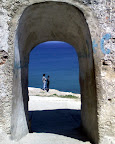
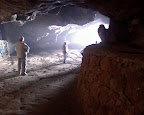
Being the helpless white people that we look like, Nacer helped us find a grand taxi to Asilah (a town known for the artwork on the walls within the medina) after our huge lunch—no big deal, there’s a veritable parking lot full of million-mile Mercedes’, right? Seems that this time of year people want to go to Asilah, but they don’t want to come back to Tangiers, so the taxis just don’t drive to Asilah. We sat around and waited. And waited. Nacer kept us company. We finally gave in and called over one of Nacer’s many friends, Mohammed, and hired him to drive us. We took the scenic coastal route, and would you believe it? Yes, Nacer remained with us for the journey. We drove past jaw-dropping estates of rich emissaries, bankers, and drug dealers. We peered at the Atlanticgrotte d'hercules  through the eye of Hercules’ caves. We drove past an area dotted with flashing red lights atop tall towers. Nacer explained it was once a French base, but is now an American base for “espionage.” I asked him what exactly he meant—I mean, if they’re spying, should it be public? He shrugged his shoulders, said he didn’t know what they do there. I guess not.
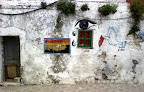
5:30pm, and we were in Asilah. Nacer shrugged off his tardiness: it was, after all, only 4pm Moroccan standard time… He (or rather, a guy he bumped into on the street) helped us look for an apartment (it’s all the rage these days to restore flats in the picturesque medina and rent them out to rich foreigners) for the night. After looking at three, I was content, and paid our “guide” for his mural in asilah services. Not so fast. Mohammed had called from the car: he ran into a friend, Zuber, and Zuber offered to put us up for free in a friend’s flat. Wow. I really didn’t know what to say to this complete stranger. Moreover, he was in charge of the fish consortium, and having noticed me eyeing the sizeable live crabs at a fishmonger’s stand, offered to arrange dinner.
Alas, the flat was not complete in its renovations. Myself, I could have stayed the night, but we wanted a real toilet seat (western toilet, but no seat) and hot water (not hooked up yet). I was mortified with the prospect of refusing Zuber’s most generous offer, but they all took it in great stride, with an air of understanding. Half an hour later we had moved into the first flat I liked. Even though it was nearly 8pm and his prospects for working that night were shot, Nacer wouldn’t agree to stay the night with us; he had class early the next morning. Goodbyes went around, complete with hugs and kisses.

Zuber would drive us to dinner, but not before some shopping. Mom spotted a couple of beautiful silver Chamsot (the Hebrew word for Hand of Fatima), they were solid silver and accordingly pricey for small gifts. Shiri upgraded to a new pair of shoes. Zuber went off to get the car, and minutes later, my phone rang. It was Nacer. The cryptic conversation went something like this: “Jonie, I forgot to tell you, don’t say you’re Jewish. I didn’t mention it, but it’s just not something to bring up in Asilah. Zuber called Mohammed and he asked about your religion after he saw what you were shopping for. Don’t worry about it, he was just being curious, it’s nothing to worry about. If he asks, tell him what I told him, that you’re just Americans.”

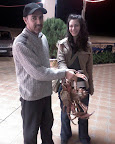
Needless to say, the drive to the restaurant was a bit awkward and definitely longer than we had expected. The redeeming moment was when Zuber unloaded our two crabs from the back of the van. We’d nacer and shiri with our crabs be eating well. Inside, we chose a couple of fish to supplement the crustaceans, and promptly got to work. Zuber force-fed us half of the lamb he ordered (he stays away from seafood whenever possible). The crabs were great, and we enjoyed the amazingly fresh fish in spite of their being overcooked. I can’t say I was surprised when he refused payment for the crabs, a preposterous gesture.
Tonight was Shiri and Ziva’s last night in Morocco, their return flights began in Casablanca, and it was time to settle on their transportation to the airport, 4-6 hours away. No sweat: take the train or find a grand taxi as a last resort. Mo helped me out, texting me the train schedules. Never simple when you’re short on time, there was a Mushkill: the only possible train was at 6:40am. The train was vetoed in favor of savoring a bit of the morning. I asked Zuber where to go the following morning to find a grand taxi. “Why didn’t you ask sooner!? We have to take care of it right away—they need to get permission from the police to go to Casablanca.” Oops. We drove around, to the pier to find his friend, back to his house to get a phone number, then to ‘a guy’s’ house. It was late. Too late—‘the guy’ was asleep and dead to the world. So we resorted to the grand taxi stand itself, and found a driver willing to make the trip—direct, no stops (I smiled and nodded, knowing I could more easily spring the stops on him during the trip). Signed, sealed, delivered. I felt terrible—Zuber was obviously exhausted. Despite being a complete stranger and weird about Jews, he had gone above and beyond for us.

Back at the flat, we finally got the chance to shower. I stepped out to get more minutes on my phone, and finding all the nearby shops closed, was at a loss. No worries, a big guy with a club in his hand was coming my way, and he looked like he might be able to help. No, really, I’m serious. He dawned a reflective fluorescent orange vest—uniform for the guardians charged with keeping the medina crime-free. Mohammed, as he was called, walked me out of the medina to a booth selling recharges, and all the way back to my place, meanwhile trying to make polite banter in FrAraSpish. This country never ceases to amaze.

Thursday, March 29

on the road with Shiri and Ziva

It was a full house come Tuesday night with EB, her mom, and her sister. The plan was for Shiri, Ziva, and I to leave for Chefchaouen early in the morning. We figured we’d take a bus—we didn’t want to deal with arranging a grand taxi, and no trains run that way. We didn’t count on stomach problems—all of us were upset in one form or another (we blame breakfast or lunch from our previous day). A new low was reached when Shiri vomited. We waited until everybody felt safe for the five-hour trip and then headed up the wet, steep hill out of the medina, carrying my one small travel umbrella and three big duffel bags.

I was soaked by the end of the ten minute walk and went off in search of a suitable taxi (the direct buses for the day had already departed) after depositing Shiri and Ziva at a café. My trusty umbrella preventing my dripping hair from getting any wetter was of little consolation—the taxis were much further than I had been led to believe. Smelling the tourist in me, the prices were inflated, and besides, there wasn’t anybody really out braving the weather, so drivers were reluctant to make the trip. In a last act of desperation, I went next door to the el-cheapo bus station (the one with the fancy buses is across town) and found an option departing in fifteen minutes. I ran (as will this sentence J) to a petit taxi, made him wait while I again ran to find my folks, pay their tab, and recharge my phone card, then got back in, rushed back to the station to purchase the tickets and get on the bus [DEEP BREATH, drip, drip].

The bus ride was fine for the most part. We had another hospitality moment as I offered some candies with the bearded man across the aisle and he reciprocated with handfuls of pistachios. We stopped in Ouezzane to change buses, drink some tea, and use the toilet. The ticket man for the connecting bus tried to overcharge me for the luggage—what did we look like, tourists? I knew better and paid him no more than his due, but these constant episodes eventually drive a person to remain home all day. Ziva was put off by the squat toilets and opted to wait, though when she was led to a different facility (they must not have grasped the issue at hand) she swallowed her concerns and performed, only to be chased back to the café by the toilet guardian who wanted—drum roll, please—payment. It got pretty windy and stomach-turning toward the destination; Shiri had me prepare a barf bag as a failsafe.

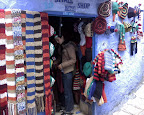
We finally got dropped off at the edge of Chaouen’s medina as the sky grew dark, and in contrast to my first visit to the town, a group of otherwise-adorable children immediately accosted us and insisted to help with our luggage. This time, though, we were prepared with candies and souvenirs. I paid them off while we had our fireplace lit up at the charming hotel. As it was already getting late, we had time for little else than dinner and a quick walk through the beautiful blue town. Not before meeting Hat Man, however—his shop a Rasta Hat Man's lair caricature, replete with the cloud of aromatic blue smoke. His knitwear was fascinating and priced so fairly I had trouble carrying out the ritualistic bargaining. Back at the hotel’s family room we found a group of men getting high and playing music. We opted to sit in, though we abstained from participating in anything but drinking tea. The hotel’s owner was an interesting Italian chap whose vibe is best summed up as a little weird. Lots of young male help, all getting high; the picture was simply disconcerting.
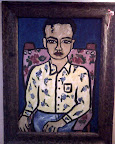
The last embers from our fire kept us warm as we slept. My alarm clock failed, causing a late awaking, and we scrambled to make the best of our short morning. Breakfast and packing was followed by some nearby gift shopping and a hasty second trip to chat with and buy more knitwear from Hat Man as we waited for our hotel-arranged grand taxi to Tangiers. It was a disappointment, then, when the taxour Italian hotelier's self-portraiti driver finally arrived but wanted double what the hotelier’s “son” had  quoted me. It was all a very shady ordeal—the hotelier got defensive rather than apologetic, insisting on the higher price. I would have been negotiating for a taxi or searching for a bus hours earlier had I not been misled to wait for the crooked taxi. Alas, on our walk over to the taxi stand, the shady driver offered a discount, and desperate (now a theme), I accepted.
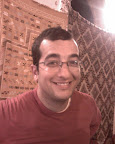
Nacer Nacer met us as we arrived at Tangiers and helped us lug our luggage up to his fifth (European=American sixth) floor walkup before a quick tour through town. The traffic in Tangiers was about as time-consuming as the drive from Chaouen. He handed us off to his friend Marouane who generously accompanied us and kept us out of trouble until we left for dinner at Nacer’s hotel. The thing is, apropos this approaching hospitality moment, is that I would rather have eaten elsewhere. I knew this even before I saw the menu (actually, it was a buffet). I agreed to the meal for the same reason I agreed to stay in Nacer’s apartment—for the magic Moroccan idea of hospitality. For the same reason they all need to give, I have almost come to feel it my duty to accept. It was not good enough for Nacer to give us a few recommendations or to hang out for a while—he needed to host us and make us feel a sense of welcome that is alien back home. So I was only slightly surprised when the manager informed me that our meal had been completely paid for by Nacer.

In a final flourish for the night, Nacer arranged for a friend to drive us home. My mom was understandably frustrated not to be able to just pay for a night at Nacer’s swanky hotel, which is what I would have insisted upon were we to do it over again. Still, as history has it, we climbed up to the apartment and bared it. Sadly, but hardly surprising us, we were without showers or western toilets. This, of course, only added fuel to my mom’s fire, and it was all we could do to go to sleep without further conflict.

Monday, March 5

moroccan hospitality

Being a proud member of the hospitality industry by choice, and actually focusing a great deal on hospitality, I place great importance on that skill-set. Though I have not yet gone to such lengths, I find myself debating whether to mimic Whitney's (EB's sister) distribution of feedback forms to close friends and loved ones. So, naturally, I am always on the lookout for new ways to give myself and to be hospitable. Even still, I am occasionally frequently taken aback by what I find here. Let me be frank: I am in a country where I rightfully and automatically assume the locals are out to part me from my money. I have mentioned it before: I don't trust many of the men (the women tend to be far less pushy and crooked) out here. Call me jaded, I call it realistic. Don't get me wrong, I don't dwell on the issue, it's just a part of life out here. Which is what makes the opposite extreme stand out that much more.

I have already written about the incident of the free pastry in Chefchaoen and Lora's hero of the night at the Casablanca bus station. Though I am unemployed, the generous exchange rate allows me to enjoy an affordably posh lifestyle. So when it comes to paying, I feel the need to pay my own way. It is rather charming, but incredibly frustrating to be constantly beat at the paying game. When grocery shopping with Mo (unemployment is contagious, and so recently we have found ourselves privileged to spend more time with him) for dinner and the like, it has become an endless fight to avoid his paying for things. Here we are, automatically rich Americans, being treated left and right by the locals who know no other way than to offer themselves  to us completely.

Food in general

The Yemenite side of my family primed me for what I could expect from Morocco and its people--Arab hospitality is like quite no other. The lengths they go to, however, still bear mentioning. By now I am already part of Mo's family. With or without EB, I am frequently invited to the house for lunch and dinner (breakfast on the weekends), and as the guidebook suggests, I have the choice morsels of meat and goodies thrust in front of me every time. I had lunch at his grandparents' house last weekend. Mo has even invited me to stay as an extended houseguest in case I decide to overstay my welcome at EB's place.

Having been invited to Miriam's place for dinner, we promptly met her and rode in a taxi to her neighborhood of Fez. The area was hopping with food stands and restaurants grilling along the main road where we were let off. Her house was vacant--her family was to have been cooking, but apparently somehow our dinner date had gone forgotten. Not a big deal--we would gladly go eat at one of the numerous places on the main drag. Fast-forward ten minutes as Mom and Sister come home. Already alerted by Miriam through the miracle of text messaging, they arrive bearing some vegetables and frozen chicken. They will have nothing of our idea to eat on the street-we are their guests, and we shall be well fed. And so we get comfortable, entertained be her young niece, snacking on pastries and sipping the ubiquitous mint tea. We end up feasting on a truly wonderful meal of tender chicken and amazing foul (braised fava beans), salads and fries. This is Moroccan hospitality.

Guide book says: if you want to eat on the train/bus, you should be prepared to offer to share your snack with all your neighbors. We offered some of our chocolate. Denied. We offered some cheese. Denied. We took out our yogurt and were hospialitily (sic)embarrassed when our neighbor offered (and we accepted) a small spoon from her purse. She offered (and we accepted) some cookies. Final seconds: we shoot, we score, as our clementines are accepted by all in the compartment.

A final show of hospitality

About a month ago, an American friend of mine was mugged--robbed with a knife to his neck. Though the first man just wanted his cash, the second intervened and took the rest of his valuables. And here's the kicker: even through a robbery, Moroccan hospitality shines--before parting, the lead robber gave him a kiss on each cheek and delivered a sincere "m'a salaama (peace to you)."